Heat Rejection Efficiency: How a Rear Door Heat Exchanger (RDHx) Cuts Fan Power Usage
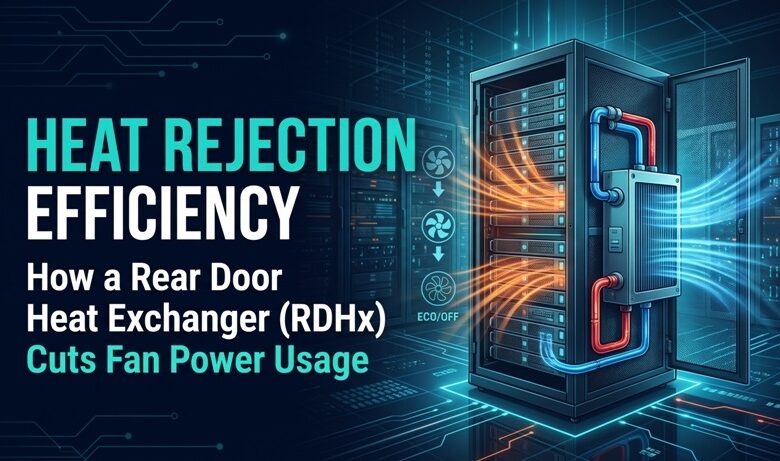
In high-density data centers, moving air has quietly become one of the single largest drains on electrical power. While server processors, memory modules, and storage drives receive most of the attention during energy audits, the fans responsible for pushing hot air out of cabinets and across rooms consume a massive share of facility electricity. As artificial intelligence clusters and enterprise servers push rack power loads to 40 kW, 70 kW, and beyond, traditional air-handling systems must spin fans at maximum speed just to keep temperatures stable. Shifting heat capture directly to the back of the server rack changes the physics of thermal transport, dramatically reducing fan energy consumption while boosting overall heat rejection efficiency.
The Hidden Energy Cost of Moving Air in Data Centers
Air is a relatively poor medium for transporting thermal energy. Because air has low density and low specific heat capacity, removing large amounts of heat requires moving enormous volumes of air across wide physical distances. In a conventional perimeter-cooled data center, chilled air must travel from Computer Room Air Handling (CRAH) units through raised-floor plenums, up through perforated tiles, across server motherboards, into hot aisles, and all the way back to ceiling returns.
Along this long pathway, air encounters constant aerodynamic resistance—known as static pressure drop—from floor grates, cable bundles, cabinet doors, and ductwork. According to the Fan Affinity Laws, the electrical power required to move air increases with the cube of the fan speed. Doubling the airflow speed to cool a denser server rack requires eight times as much fan power. Consequently, conventional air-cooled facilities suffer from two compounding energy penalties:
- Perimeter Blower Parasitic Load: Large CRAH and CRAC centrifugal blowers run continuously at high RPMs to overcome room-wide pressure drops, consuming 10% to 20% or more of total facility power.
- Server Chassis Fan Ramp-Up: When hot exhaust air recirculates into cold aisles and raises server inlet temperatures, internal server fans automatically accelerate to protect components, spiking IT power draw without adding a single cycle of compute performance.
Capturing Heat Directly at the Cabinet Boundary
Deploying a Rear Door Heat Exchanger Rdhx eliminates long-distance air transport by intercepting thermal energy right where it exits the server chassis, and EXTRCOOL INDUSTRY LIMITED designs high-efficiency liquid-cooled rear door systems engineered to maximize heat rejection with minimal airflow resistance. Instead of allowing hot exhaust air to travel across the room to distant air handlers, an RDHx replaces the standard rear cabinet door with a precision liquid-to-air heat exchanger coil.
As internal server fans push warm exhaust air out the back of the IT equipment, the air immediately passes through closely spaced aluminum fins bonded to copper or stainless-steel water tubes. Circulating chilled water or coolant inside the tubes absorbs thermal energy directly from the passing air stream, returning the air to ambient room temperature within inches of the server rear panel. The warmed liquid is then carried through closed-loop piping to a Coolant Distribution Unit (CDU) or chiller plant for outdoor heat rejection.
- Eliminating Room-Wide Airflow Loops: Because air is cooled back to room temperature before leaving the rack boundary, perimeter air handlers no longer need to push massive volumes of chilled air across the white space.
- Leveraging Liquid Heat Capacity: Water carries roughly 3,500 times more heat per unit volume than air, allowing compact, high-efficiency water pumps to transport thermal energy using a tiny fraction of the electricity consumed by large air blowers.
- Ultra-Low Airside Pressure Drop: Precision-engineered coil geometry ensures air passes smoothly through the heat exchanger without forcing internal server fans to work harder.
How RDHx Cuts Both Facility and Server Fan Power
Reducing fan power usage occurs simultaneously at the facility level and inside every individual server chassis. By optimizing both sides of the thermal equation, rack-level heat rejection delivers compounding energy savings across the entire power distribution chain.
- Shutting Down or Slowing Perimeter CRAH Blowers: Once rear door coils capture 95% to 100% of server exhaust heat at the rack, perimeter air handlers are relieved of their primary cooling load. Facilities can turn off redundant CRAH units or drop variable-frequency drive (VFD) fan speeds to minimum baseline levels, slashing facility blower wattage immediately.
- Stabilizing Server Inlet Temperatures: Because rear door units prevent hot exhaust air from spilling into aisles or wrapping around racks, server inlet temperatures remain rock-steady across every row. Without sudden temperature spikes, internal server fans stay at low, energy-efficient RPMs.
- Passive Airflow Utilization: Passive RDHx models contain no fans of their own. Instead, they rely entirely on the existing static pressure generated by internal server fans to push exhaust air through a low-resistance coil—achieving full heat rejection with zero additional fan electricity.
- Intelligent Variable-Speed Active Control: For ultra-dense racks exceeding 60 kW to 100 kW or high-resistance server hardware, active RDHx models incorporate electronically commutated (EC) fans that modulate speed dynamically based on real-time exhaust temperature sensors, consuming power only in exact proportion to actual IT workload.
Engineering Factors That Maximize Heat Rejection Efficiency
Not all rear door heat exchangers achieve the same balance between thermal transfer and low airflow resistance. High-performance systems rely on specialized thermal engineering to extract maximum heat per liter of coolant while keeping airside pressure drop minimal.
- Fin Geometry and Tube Pitch: Optimized fin spacing, louvered fin surfaces, and staggered tube layouts create controlled micro-turbulence in the air stream. This breaks up thermal boundary layers on metal surfaces for rapid heat absorption without blocking airflow.
- Counter-Flow Coolant Circuiting: Routing cold supply water opposite to the direction of warm exhaust airflow maintains a strong temperature differential across the entire coil face, maximizing heat rejection efficiency even when operating with warmer supply water temperatures.
- Modulating Two-Way Flow Valves: Automated control valves adjust water flow rates continuously based on supply-and-return air temperatures. This prevents over-pumping during off-peak server utilization, saving pump energy alongside fan energy.
- Above-Dew-Point Thermal Control: Operating coolant loops slightly above the room dew point prevents moisture condensation on fin surfaces, keeping air passages dry and unobstructed while enabling extended economizer and dry-cooler operation.
Operational and Financial Benefits Beyond Fan Savings
Cutting fan power usage creates a ripple effect of operational improvements across modern and legacy data centers alike. Every kilowatt saved on cooling fans becomes directly available to power revenue-generating compute hardware or reduce monthly utility expenses.
- Improved Power Usage Effectiveness (PUE): Reducing parasitic fan power brings facility PUE closer to 1.1 or lower, helping organizations meet strict corporate sustainability targets and energy efficiency regulations.
- Quieter Data Center Environments: Lowering fan speeds across both CRAH units and server chassis noticeably reduces acoustic noise levels on the server floor, improving technician safety and comfort.
- Extended Component Lifespan: Fans running at lower rotational speeds experience less bearing wear and mechanical vibration, reducing hardware replacement cycles and maintenance overhead.
- Seamless Scalability for AI Workloads: With engineering guidance from EXTRCOOL INDUSTRY LIMITED, data center operators can deploy high-density racks in existing rooms without upgrading raised-floor airflow capacity or installing bulky overhead ductwork.
Transitioning Toward High-Efficiency Rack Cooling
Relying on room-scale air circulation to cool modern high-density servers is an uphill battle against basic physics. Moving massive volumes of air across long distances wastes valuable electrical capacity and limits how much compute power a facility can safely support. By capturing heat directly at the back of the cabinet, a rear door heat exchanger replaces inefficient air transport with high-capacity liquid heat rejection—cutting fan power usage at both the server and room levels. Backed by proven thermal engineering and global deployment experience, EXTRCOOL INDUSTRY LIMITED enables data centers to achieve superior heat rejection efficiency and sustainable high-density performance.
Learn more about high-efficiency rack cooling solutions at https://www.extrcool.com/.