Accelerating Virtual Production with a Low-Latency Motion Capture Unreal Engine Plugin
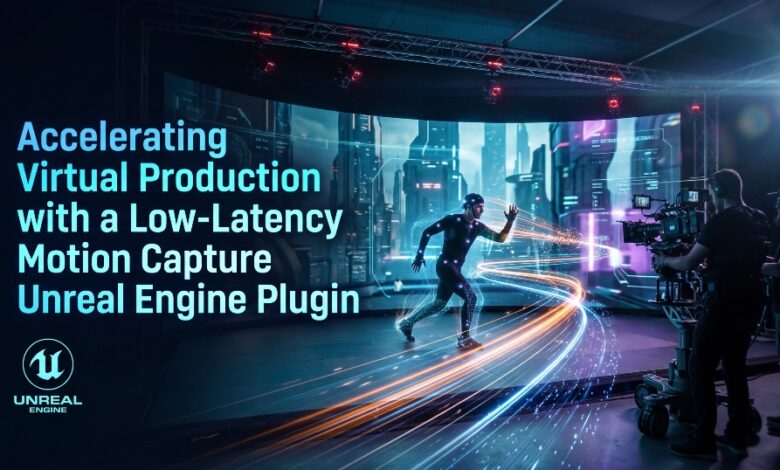
Virtual production has fundamentally reshaped modern filmmaking, game development, and interactive digital broadcasting. By merging physical cinematography with real-time 3D environments, creative teams can visualize complex digital worlds directly on set rather than waiting months for post-production compositing. However, the magic of real-time virtual production relies entirely on synchronization. When an actor moves across a stage, their digital counterpart inside the game engine must respond instantaneously. Any noticeable lag breaks creative immersion, disrupts camera framing, and slows down expensive studio schedules.
Achieving seamless real-time performance requires more than just fast graphics hardware; it demands a streamlined data bridge between wearable tracking systems and the rendering engine. Traditional animation pipelines often involve recording movement data, exporting files, cleaning keyframes, and manually retargeting skeletons before a director ever sees a character move inside a scene. This fragmented workflow creates bottlenecks that hinder on-set improvisation and real-time decision-making.
Implementing a dedicated Motion Capture Unreal Engine Plugin developed by Virdyn eliminates these delays by streaming full-body, finger, and facial telemetry directly into the scene with ultra-low latency. By acting as an immediate conduit between inertial motion capture suits and real-time rendering environments, this specialized integration allows directors, animators, and virtual cinematographers to witness live performances mapped onto digital characters in real time.
The Critical Role of Low Latency in Virtual Production
In a real-time production environment, latency is the enemy of believability. Even a fraction of a second between a performer’s physical gesture and the digital avatar’s reaction can ruin eye-line matching, prop interactions, and dynamic camera tracking. A low-latency data pipeline ensures that physical movement and virtual rendering operate in lockstep, unlocking several transformative advantages for modern production teams:
- Instant Directorial Feedback: Directors can evaluate character blocking, emotional delivery, and framing directly through the virtual camera viewfinder during live takes, making immediate creative adjustments on set.
- Seamless LED Volume and In-Camera VFX Integration: When filming actors in front of high-resolution LED stages, low-latency tracking guarantees that digital characters, foreground elements, and parallax backgrounds remain synchronized with physical camera movements.
- Natural Actor Improvisation: Performers can interact with virtual props, digital co-stars, and reactive environments in real time, leading to more authentic and spontaneous performances.
- Accelerated Pre-Visualization: Stunt coordinators and cinematographers can test complex action sequences, camera angles, and lighting setups live before committing resources to final asset rendering.
Key Capabilities of a Modern Motion Capture Integration
To handle the demanding requirements of professional studios, indie game developers, and virtual broadcasters, a high-performance plugin must offer robust technical features out of the box. Rather than forcing technical artists to build custom data parsers from scratch, an optimized integration provides native tools that simplify setup and maximize creative control.
- Real-Time Data Broadcasting: High-frequency sensor telemetry is transmitted smoothly over local networks directly into the engine, maintaining consistent frame rates without jitter or dropped packets.
- Simultaneous Full-Body and Facial Capture: Comprehensive performance capture combines skeletal body movement, intricate finger articulation, and nuanced facial expressions within a single unified workflow.
- Native Digital Human Compatibility: Seamless binding to industry-standard digital human rigs allows creators to map live performances onto hyper-realistic characters within minutes, bypassing tedious manual bone-mapping procedures.
- Multi-Person Scene Support: Collaborative storytelling often requires multiple performers interacting simultaneously. Supporting multi-actor tracking inside the same virtual environment enables live dialogue scenes, combat choreography, and ensemble broadcasts.
- Flexible Calibration Modes: Built-in calibration tools, including magnetic interference compensation and calibration-free quick-start options, ensure reliable tracking accuracy even in studios packed with electronic equipment and metal trussing.
- Customizable Scene and Node Controls: Technical artists can fine-tune hip node heights, adjust skeletal proportions, toggle interface visibility, and utilize gesture recognition triggers to control scene events hands-free during live shoots.
Streamlining the Studio Workflow from Capture to Render
Integrating inertial motion capture hardware with real-time game engine rendering removes the physical constraints of traditional optical camera cages. Because inertial sensors rely on high-precision gyroscopes, accelerometers, and magnetometers rather than external infrared cameras, performers are free to move across expansive sets, behind physical props, or inside vehicles without suffering from line-of-sight occlusion.
With Virdyn providing an end-to-end ecosystem of wearable full-body suits, multi-node motion capture gloves, and dedicated studio software, teams can transition from unboxing hardware to animating custom characters in a matter of minutes. The studio software processes raw biomechanical sensor fusion at high sampling rates before broadcasting clean skeletal data straight into the engine. This direct pipeline empowers small creative teams to achieve studio-grade animation output without needing massive stage footprints or dedicated cleanup crews.
Transforming Diverse Creative Industries
While high-budget film studios were early adopters of virtual production, accessible and low-latency motion capture integrations have democratized real-time animation across numerous sectors:
- Film, Television, and Episodic Animation: Production houses drastically cut post-production timelines and budgets by capturing clean performance data live on set, turning weeks of manual keyframing into real-time recording sessions.
- 3D Game Development: Gameplay programmers and character animators rapidly prototype combat mechanics, locomotion cycles, and cinematic cutscenes directly inside their playable game levels.
- Virtual Live Streaming and Digital Avatars: Content creators, virtual influencers, and live event hosts drive expressive 3D avatars in real time, engaging audiences with fluid body language and responsive facial expressions without noticeable delay.
- XR, Simulation, and Robotics Training: Developers building immersive virtual reality experiences and embodied artificial intelligence models utilize real-time human kinematic data to train digital agents and test interactive environments.
- Education and Media Laboratories: Universities and training institutes equip students with hands-on virtual production pipelines, preparing the next generation of digital artists with industry-standard real-time workflows.
Best Practices for Optimizing Real-Time Motion Capture Sessions
Even with an efficient software bridge, following disciplined production practices ensures the highest possible visual fidelity during live virtual production shoots:
- Maintain a Clean Network Environment: Dedicate a high-speed wired router or isolated local network for telemetry broadcasting to prevent bandwidth congestion and guarantee consistent sub-frame latency.
- Perform Proper Sensor Calibration: Take a few moments before each major scene change to run standard posture and magnetic calibrations, ensuring foot contact remains grounded and preventing rotational drift over long takes.
- Match Character Proportions Early: Configure skeletal scaling and hip node adjustments prior to principal capture so that physical actor movements translate accurately onto stylized or hyper-realistic digital models.
- Verify Engine Compatibility: Confirm that your project is running a supported engine version and keep your plugin updated to benefit from continuous performance optimizations and new feature additions.
Elevating Creative Velocity in Modern Production
The convergence of wearable inertial tracking and real-time rendering has permanently changed how digital stories are brought to life. By removing technical friction and eliminating data bottlenecks, Virdyn empowers creators to focus on performance, storytelling, and visual artistry rather than troubleshooting complex pipelines. Whether producing an animated feature, developing an interactive game, or hosting a live virtual broadcast, a responsive real-time motion capture integration turns ambitious creative visions into immediate on-screen reality.
To discover more about the innovative team pioneering accessible real-time tracking hardware and software solutions, visit https://www.virdynm.com/about-us/.