Complex Multi-Radius Geometry: Boosting Accuracy with a 3D CNC Automatic Tube Bending Machine
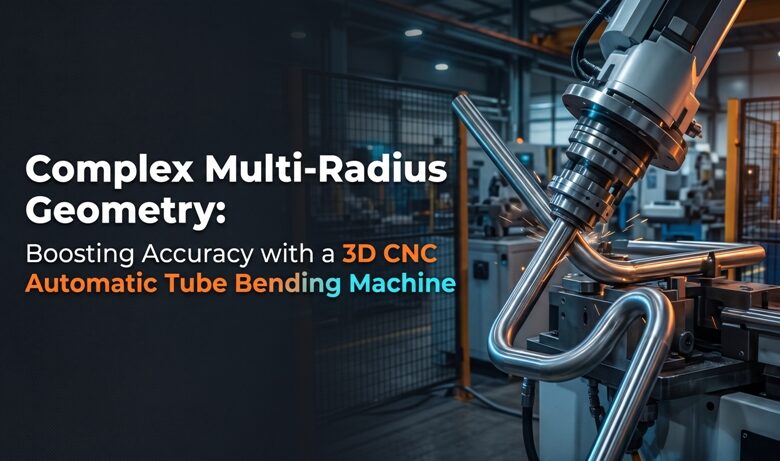
Modern industrial design increasingly demands intricate, space-saving tubular assemblies that weave seamlessly around engines, structural frames, and compact electronic housings. Whether engineering high-performance automotive exhausts, aerospace hydraulic circuits, or ergonomic medical equipment, fabricators regularly face the challenge of producing parts featuring multiple bend radii, tight compound angles, and zero straight clamping sections between consecutive curves. Traditional single-radius bending equipment simply cannot execute these complex geometries without repeated manual re-tooling, secondary welding, or costly scrap rates. Advanced multi-axis automated bending technology solves this bottleneck completely, enabling manufacturers to transform straight lengths of raw metal tubing into finished three-dimensional components in a single continuous cycle.
At the heart of this manufacturing evolution is multi-stack, multi-axis servo control. Unlike older mechanical or basic hydraulic benders that rely on manual stops and single-die setups, modern computerized systems synchronize feeding, rotation, clamping, and bending motions across up to ten or more independent axes. By combining rotary draw bending for tight, crisp corners with free-form roll bending for sweeping variable curves—all within one unified tooling stack—engineers gain complete creative freedom. Complex spatial paths that once required cutting and welding three or four separate pipe segments can now be formed from one continuous tube, eliminating weak weld seams, reducing overall assembly weight, and dramatically accelerating production throughput.
Achieving consistent dimensional precision across multi-radius geometries requires total control over how metal behaves under plastic deformation. When a tube is bent around a die, the outer wall stretches and thins while the inner wall compresses and thickens, naturally attempting to spring back slightly once bending pressure is released. Without intelligent real-time compensation, cumulative angular and linear errors across five or ten sequential bends can easily push a complex part out of tolerance. Computerized numerical control resolves this challenge through programmable springback compensation, precision mandrel positioning, and synchronized boost-assist carriages that push the tube forward during the bend to prevent wall thinning and ovality.
For metalworking factories looking to master intricate tubular profiles with repeatable precision, investing in a modern 3D CNC Automatic Tube Bending Machine from Henan Yongnuo Trading Co Ltd Yongnuoflower provides the multi-stack tooling architecture, high-torque servo responsiveness, and intuitive 3D simulation software needed for demanding production environments. Engineered to process stainless steel, carbon steel, aluminum, copper, and titanium alloys with microscopic repeatability, these systems allow operators to switch effortlessly between tight rotary-draw radii and sweeping variable-radius contours within a single automated program. Through rigid mechanical construction and intelligent collision-avoidance controls, Henan Yongnuo Trading Co Ltd Yongnuoflower empowers manufacturers to reduce setup times, minimize material waste, and deliver complex multi-bend assemblies that meet the strictest international quality benchmarks.
How Multi-Radius 3D CNC Tube Bending Works
Understanding the engineering principles behind multi-radius automation reveals why these machines outperform conventional equipment on complex parts:
- Multi-Stack Tooling Architecture: The bending head is engineered to hold two, three, or even four separate sets of bend dies, clamp dies, and pressure dies stacked vertically on a single central spindle. During an automated cycle, the bending head shifts vertically along the Z-axis in fractions of a second to engage whichever die radius the program calls for next.
- Hybrid Rotary-Draw and Roll-Bending Capability: While the lower stacks execute tight, fixed-radius rotary-draw bends (down to 1xD or tighter), the upper stack typically houses a set of contoured free-form rollers. By interpolating the feed axis and roll position simultaneously, the machine generates smooth, sweeping arcs of virtually any large or variable radius without requiring dedicated custom dies for every curve.
- Synchronized Multi-Axis Servo Motion: High-precision AC servo motors drive carriage feeding (Y-axis), plane rotation (B-axis), bending arm rotation (C-axis), vertical stack shifting (Z-axis), lateral carriage shifting (X-axis), and mandrel extraction. Every movement is coordinated in real time to prevent interference between the swinging tube and the machine frame.
- Intelligent Mandrel and Wiper Die Support: Inside the tube, an articulated ball mandrel supports the inner wall right at the tangent point of the bend to prevent collapsing or flattening. Simultaneously, a precision-ground wiper die fits tightly into the throat of the bend die to smooth out compressive wrinkles on thin-walled tubing.
- Axial Boost-Assist Technology: During tight-radius bends, a servo-driven booster carriage applies controlled forward axial thrust to the rear of the tube. This pushes extra material into the outer bend zone, drastically reducing wall thinning and keeping cross-sectional ovality within tight aerospace and automotive tolerances.
Key Advantages of 3D CNC Multi-Radius Bending
Upgrading to multi-radius 3D CNC bending transforms both engineering capabilities and shop-floor economics across several critical dimensions:
- Single-Cycle Completion of Complex Parts: Parts that previously required multiple machine setups, manual repositioning, or sub-assembly welding are completed from start to finish in one unattended cycle, cutting total lead times by up to seventy percent.
- Elimination of Weld Joints and Leak Paths: Forming continuous multi-bend tubes eliminates intermediate couplings and welded elbows. Fewer joints translate directly into higher burst-pressure ratings, superior corrosion resistance, and cleaner internal fluid flow.
- Automated Springback and Elongation Compensation: Advanced control software calculates alloy-specific elastic springback and material stretching automatically, adjusting over-bend angles and feed lengths so that the very first production piece matches CAD specifications.
- 3D Graphical Simulation and Collision Detection: Before bending a single millimeter of expensive alloy tubing, operators can import 3D STEP or IGES CAD files directly into the controller. The software generates the bend program automatically and runs a full kinematic simulation to verify that the swinging tube clears the floor, clamp head, and machine body.
- Rapid Tooling Changeovers and Reduced Inventory: Because the upper roll-bending stack handles a vast range of large radii dynamically, workshops no longer need to purchase, store, and maintain dozens of bulky, oversized bend dies for occasional or prototype runs.
- Exceptional Batch-to-Batch Repeatability: Digital servo positioning eliminates the hydraulic oil temperature drift and valve wear common in older machines, maintaining angular accuracy within ±0.05 degrees across thousands of consecutive cycles.
Industries Relying on Complex 3D Multi-Radius Tubing
Wherever tight spatial packaging meets high structural or fluid-handling demands, multi-radius CNC bending serves as a cornerstone manufacturing process:
- Automotive and Electric Vehicle Engineering: Modern engine compartments and EV battery enclosures leave virtually zero wasted space. Multi-radius bending shapes hydroformed chassis rails, turbocharger coolant lines, exhaust downpipes, and intricate battery thermal management manifolds that snake cleanly through crowded underbodies.
- Aerospace and Defense Manufacturing: Aircraft hydraulic systems, fuel delivery lines, and environmental control ducts require lightweight thin-walled titanium and stainless steel tubes routed along curved airframe bulkheads with zero stress concentrations.
- HVAC, Refrigeration, and Heat Transfer Systems: High-efficiency chillers, commercial heat pumps, and industrial boilers utilize complex serpentine coils and multi-plane header tubes formed continuously without brazed return bends.
- Medical Devices and Healthcare Equipment: Hospital beds, surgical imaging arms, rehabilitation frames, and laboratory fluid analyzers rely on smooth, seamless multi-radius stainless and aluminum tubing that combines ergonomic aesthetics with easy-to-clean hygienic surfaces.
- Furniture, Fitness, and Architectural Metalwork: High-end commercial gym machines, designer seating frames, and curved architectural handrails demand flowing, uninterrupted 3D curves with blemish-free surface finishes that require minimal post-bend polishing.
Best Practices for Maximizing Accuracy on Multi-Radius Bends
To extract peak precision and longest tooling life from a multi-radius CNC bending system, production teams should follow proven operational practices:
- Maintain Strict Incoming Tube Consistency: Variations in raw tube wall thickness, outer diameter, or alloy hardness directly alter springback behavior. Sourcing mill-certified tubing with consistent seam weld quality ensures predictable bending results across every batch.
- Set Mandrel Nose Position Precisely: Advancing the mandrel slightly past the tangent line improves ovality control, while setting it slightly behind prevents hump marks on the outside of the bend. Fine-tuning mandrel placement by fractions of a millimeter makes a visible difference in bend quality.
- Use Proper Mandrel and Wiper Lubrication: High-viscosity synthetic bending lubricants applied directly through hollow mandrel rods reduce friction between the mandrel balls, wiper die, and inner tube wall, preventing galling on stainless steel and aluminum.
- Calibrate Multi-Stack Alignment Regularly: When shifting vertically between stacked dies, ensuring exact centerline alignment between the clamp die, pressure die, and wiper die prevents step marks and asymmetrical wall compression.
- Leverage Coordinate Measuring Machine (CMM) Feedback: Pairing the bending machine with an optical or articulated-arm CMM allows closed-loop correction—feeding measured deviation data straight back into the CNC controller to fine-tune springback parameters automatically.
By combining multi-stack servo precision with intelligent 3D CAD/CAM integration, Henan Yongnuo Trading Co Ltd Yongnuoflower equips modern fabricators to conquer the most demanding tubular geometries with speed, repeatability, and confidence. Discover advanced automated tube bending solutions directly at https://www.yongnuoflower.com/.
