DAC Copper Cable: Benefits, Applications, and Selection Tips for Data Center Networks — REALSEA Optical Technology Co Ltd
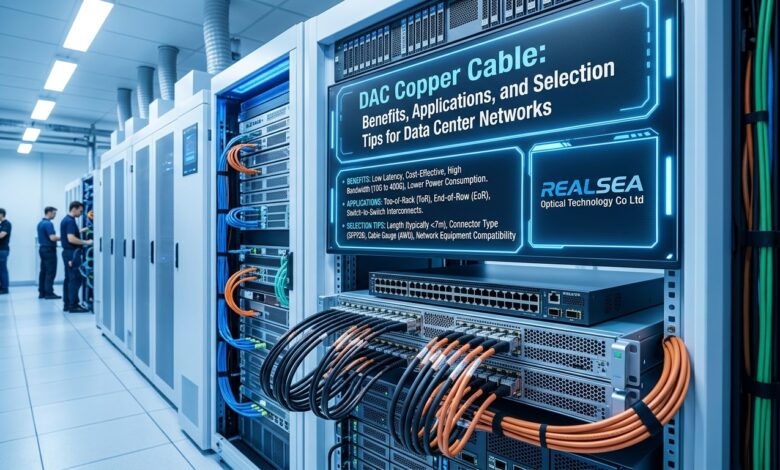
Modern data centers require high-speed, reliable, and cost-effective connectivity to handle increasing volumes of digital information. As cloud computing, artificial intelligence, virtualization, and enterprise applications continue to expand, network infrastructure must support faster communication between servers, switches, and storage systems. One essential component of this infrastructure is the DAC copper cable, a practical connectivity solution designed for short-distance, high-speed data transmission. Its simple installation, low power consumption, and reliable performance make it an attractive option for modern networking environments.
Data center operators constantly look for ways to improve network performance while controlling equipment costs and energy consumption. Traditional optical connections provide excellent transmission capabilities, particularly over longer distances, but not every networking application requires optical fiber. Short-distance connections within server racks or between nearby switches can often benefit from direct attach copper technology. These cables combine integrated connectors with copper conductors, helping eliminate the need for separate optical transceivers while supporting high-bandwidth communication across compatible devices.
A Dac Copper Cable is an important connectivity option in the networking solutions associated with REALSEA Optical Technology Co Ltd, particularly for organizations exploring efficient short-reach data center connections. Direct attach copper cables help simplify network installations by combining the cable and connector assemblies into a single solution. Understanding their technical characteristics, practical applications, and selection requirements allows network professionals to develop reliable connectivity systems while balancing performance, operational simplicity, and infrastructure costs.
1. What Is a DAC Copper Cable?
A Direct Attach Copper (DAC) cable is a high-speed networking cable assembly that connects compatible communication devices through copper conductors and integrated transceiver-style connectors. Unlike conventional fiber-optic connections, which require optical signal conversion, DAC cables transmit electrical signals directly between connected equipment.
These cables are commonly used with networking interfaces such as SFP+, SFP28, QSFP+, QSFP28, and QSFP-DD, depending on their design and supported data rates. They provide convenient connections between switches, servers, network adapters, and storage equipment within relatively short distances.
One distinguishing feature of DAC technology is its integrated construction. Instead of purchasing separate transceivers and fiber-optic cables, network administrators can use a complete copper cable assembly with compatible connectors already attached. This approach reduces the number of individual components involved in installation.
DAC cables generally fall into two categories: passive and active. Passive DAC cables contain copper conductors without powered signal-conditioning electronics, while active DAC cables incorporate circuitry that helps maintain signal integrity over supported distances.
The choice between these two designs depends on cable length, signal quality requirements, equipment compatibility, and power considerations. Both types offer practical advantages when used in suitable networking environments.
2. Major Benefits of DAC Copper Cables in Data Centers
DAC copper cables offer several advantages that make them suitable for short-distance networking applications. Their combination of affordability, simplicity, and high-speed transmission capabilities helps organizations build efficient communication infrastructure.
Cost-Effective Connectivity
One of the most attractive benefits of DAC technology is its potential to reduce connectivity costs. Because the cable assembly includes integrated electrical interfaces, network operators generally do not need separate optical transceivers and fiber patch cables for the same short-reach link.
This can make DAC connections economical for installations involving numerous server-to-switch connections. In large data centers, even modest savings on individual links can contribute to meaningful reductions in equipment expenditure.
Low Power Consumption
Passive DAC cables typically consume very little additional power because they do not require the optical transmitters and receivers found in optical transceiver systems. Active DAC cables consume more power than passive versions because they include signal-conditioning electronics, but they can still be efficient choices for appropriate applications.
Lower connectivity power requirements can help organizations manage total energy consumption and cooling demand.
Simple Installation
DAC cables arrive as integrated assemblies, which simplifies deployment. Network technicians can connect compatible devices without separately installing optical modules or matching transceiver specifications with fiber patch cords.
This straightforward approach can reduce installation complexity and make routine equipment replacement more convenient.
Reliable Short-Distance Performance
DAC cables provide high-speed electrical connectivity over short distances. When properly selected and installed, they can support stable communication with low transmission latency.
Their practical advantages make them particularly valuable in high-density networking environments where efficient installation and dependable short-reach performance are priorities.
3. Passive vs. Active DAC Copper Cables
Understanding the difference between passive and active DAC cables is essential when selecting the right solution for a particular network.
Passive DAC cables transmit electrical signals through copper conductors without incorporating powered signal-conditioning components. Their simple architecture makes them attractive for short-distance applications where the connected devices provide adequate signal quality.
Because passive cables generally require minimal additional power, they are frequently used for connections within the same rack or between equipment positioned close together.
Active DAC cables, on the other hand, include electronic components designed to improve signal transmission characteristics. These components can help compensate for signal degradation associated with cable length and high-frequency transmission.
The additional circuitry makes active DAC cables suitable for certain applications where passive cables may not provide sufficient signal integrity.
| Feature | Passive DAC cable | Active DAC cable |
|---|---|---|
| Signal conditioning | No powered signal conditioning | Includes active signal-conditioning circuitry |
| Power requirements | Very low | Higher than passive DAC |
| Typical distance | Short connections | Can support longer connections, depending on design |
| Cost | Generally lower | Generally higher |
| Installation | Integrated cable assembly | Integrated cable assembly |
| Common applications | Same-rack connections | Longer short-reach data center links |
Actual supported distances vary according to cable construction, data rate, host capabilities, and applicable interface specifications.
Choosing the correct type requires evaluating the complete connection rather than assuming one cable category will work in every environment.
4. Common DAC Cable Types and Supported Speeds
DAC copper cables are available in multiple connector configurations, allowing them to support different network bandwidth requirements.
10G SFP+ DAC Cables
SFP+ DAC cables are commonly used for 10 Gigabit Ethernet connections. They provide a practical option for connecting compatible servers, switches, and network adapters over short distances.
Their compact design and straightforward installation make them suitable for enterprise networking and data center access connections.
25G SFP28 DAC Cables
SFP28 DAC cables commonly support 25 Gigabit Ethernet connectivity. They are useful in networking environments requiring higher bandwidth per server connection while maintaining compact physical interfaces.
These cables are especially relevant to modern server-to-switch architectures.
40G QSFP+ DAC Cables
QSFP+ DAC cables commonly support 40 Gigabit Ethernet applications. Their multi-lane architecture provides greater transmission capacity than traditional 10G connections.
They are often used for aggregation and switching applications requiring additional bandwidth.
100G QSFP28 DAC Cables
QSFP28 DAC cables support compatible 100 Gigabit Ethernet applications and are commonly used in high-capacity data center environments.
They provide an option for connecting compatible switches and networking systems where substantial bandwidth is required over short distances.
Higher-Speed DAC Configurations
Advanced DAC assemblies are also available for supported 200G, 400G, and other high-capacity interfaces. These designs require careful consideration of electrical signaling, cable length, connector compatibility, and signal integrity.
Selecting the appropriate cable type helps ensure that the networking infrastructure supports the intended transmission requirements.
5. Applications of DAC Copper Cables in Modern Networks
DAC copper cables are used in a variety of networking environments where high-speed communication is required across relatively short distances.
One of their most common applications is server-to-switch connectivity. In data centers, servers frequently connect to top-of-rack switches located within the same equipment rack. DAC cables provide a convenient option for these short connections because they combine the required electrical interfaces into a single cable assembly.
Another important application is switch-to-switch communication. Nearby switches may need to exchange substantial volumes of information, making high-bandwidth DAC connections useful where the distance and interface specifications permit their use.
Storage networking also benefits from suitable DAC configurations. Systems that require fast communication between storage devices and networking infrastructure can use compatible copper connections to support demanding data transfer operations.
DAC cables are also relevant to high-performance computing and artificial intelligence environments. These systems often contain densely packed computing equipment that depends on high-speed connections between network devices.
In enterprise networks, DAC technology can simplify short-reach connections inside equipment rooms and network cabinets.
Across these applications, the primary advantage remains consistent: DAC cables offer a practical method of establishing high-speed connections without requiring separate optical transceiver assemblies.
6. DAC Copper Cable vs. Fiber-Optic Cable
Both DAC copper cables and fiber-optic cables play important roles in modern network infrastructure. However, their characteristics make them suitable for different communication requirements.
DAC cables use electrical signals transmitted through copper conductors. Fiber-optic cables carry information through light signals, typically using optical transceivers at each end of the link.
One major difference is transmission distance. DAC cables are primarily intended for short-reach connections, while fiber-optic systems can support substantially longer distances depending on the optical modules and fiber infrastructure.
DAC cables can offer cost advantages for nearby equipment connections because they eliminate separate optical components.
Fiber-optic connections, however, provide advantages in applications requiring longer reach, electrical isolation, or resistance to electromagnetic interference.
| Comparison factor | DAC copper cable | Fiber-optic connection |
|---|---|---|
| Transmission medium | Copper conductors | Optical fiber |
| Signal type | Electrical | Optical |
| Typical application | Short-distance networking | Short- and long-distance networking |
| Separate optical transceivers | Not required | Generally required |
| Power consumption | Very low for passive DAC | Depends on optical transceivers |
| Electromagnetic interference | Requires suitable shielding and design | Fiber is immune to electromagnetic interference |
| Installation | Integrated cable assembly | Fiber and compatible optical interfaces |
| Cost considerations | Often economical for short links | Often preferable for longer-reach requirements |
Neither technology is universally superior. The most effective choice depends on the physical distance, bandwidth, equipment interfaces, environmental conditions, and overall deployment budget.
For networks containing both short- and long-distance connections, combining DAC and optical solutions can provide an efficient infrastructure strategy.
7. How to Choose the Right DAC Copper Cable
Selecting a suitable DAC copper cable requires careful consideration of several important factors.
The first is network speed compatibility. A cable must support the intended data rate and the electrical interface requirements of the connected devices. A cable designed for one interface or transmission standard should not automatically be assumed compatible with another.
Cable length is another critical consideration. DAC connections are generally limited to relatively short distances because electrical signal quality becomes more challenging to maintain as cable length increases.
Passive DAC cables are often suitable for very short connections, while active versions may provide additional options where signal-conditioning requirements are greater.
Connector compatibility should also be verified. Common DAC interfaces include SFP+, SFP28, QSFP+, QSFP28, and QSFP-DD, but physical appearance alone does not guarantee that a cable will operate correctly with a particular networking device.
Cable construction matters as well. Factors such as conductor quality, shielding, cable thickness, and mechanical flexibility influence installation convenience and signal integrity.
Data center operators should also consider cable routing. Excessive bending, tight cable bundles, or poorly organized cable paths can create maintenance difficulties and may affect cable performance.
Finally, technical documentation and testing information should be reviewed. Confirming the relevant specifications before purchasing helps organizations avoid compatibility issues and unnecessary deployment delays.
8. Installation and Maintenance Best Practices
Proper installation plays an important role in maintaining reliable DAC cable performance.
Before installing a cable, network technicians should confirm that the connected equipment supports the cable assembly and intended transmission speed. Reviewing device specifications and supported interface requirements can prevent common connectivity problems.
Careful cable handling is equally important. DAC cables should not be bent beyond their specified minimum bend radius or subjected to excessive pulling force. Improper handling may damage the cable assembly or affect its electrical characteristics.
Organized cable management helps maintain airflow and makes maintenance easier. High-density network racks often contain numerous cable connections, so keeping cables properly routed and labeled reduces confusion during troubleshooting or equipment replacement.
Technicians should also ensure that connectors are inserted correctly and securely. Loose or improperly seated connections can lead to unreliable communication.
Routine inspections can help identify physical damage, excessive strain, or other installation issues. Where supported, network monitoring systems can provide information about link status and error conditions.
Maintaining accurate records of cable lengths, connection locations, and equipment compatibility also supports efficient network administration.
These practical measures help organizations preserve reliable connectivity while simplifying day-to-day operations.
9. Improving Data Center Efficiency With DAC Technology
Efficient data center operations depend on balancing performance, power consumption, installation complexity, and maintenance requirements.
DAC copper cables can contribute to this balance by providing high-speed electrical connectivity for nearby networking devices. Their integrated design reduces the number of separate components needed for certain links, which may simplify purchasing and installation.
Power efficiency is another important consideration. Passive DAC assemblies generally require minimal additional power compared with optical transceiver-based solutions. Across a large installation, selecting suitable low-power connections can contribute to better energy management.
DAC technology can also support organized network design. Short server-to-switch connections are common in top-of-rack architectures, where networking devices are positioned close to the servers they support.
Using appropriately sized DAC cables in these environments can help avoid unnecessary cable length and reduce installation complexity.
However, network planners should consider cable thickness and airflow requirements. Copper assemblies can be bulkier than some optical fiber connections, particularly at higher data rates or with thicker conductors.
For this reason, DAC cables are most effective when their electrical and mechanical characteristics match the infrastructure design.
By evaluating these practical requirements, data center operators can use direct attach copper connectivity to improve efficiency without compromising network reliability.
10. Future Trends in DAC Copper Cable Technology
As data center bandwidth requirements continue to increase, DAC technology is evolving to support more demanding networking applications.
Higher-speed Ethernet interfaces are creating opportunities for advanced copper cable assemblies. Modern DAC designs must address increasingly complex electrical signaling requirements while maintaining suitable performance over short distances.
Improved cable construction, connector designs, and signal-conditioning technologies are important areas of development. These improvements can help support higher data rates while managing signal attenuation, electromagnetic interference, and physical installation requirements.
High-density networking environments also influence cable design. Data centers increasingly require compact connectivity solutions capable of supporting substantial bandwidth within limited rack space.
Energy efficiency remains another important priority. As organizations expand their computing infrastructure, minimizing unnecessary power consumption becomes essential for controlling operating costs.
DAC connections may continue to serve short-reach applications where their cost and energy advantages make practical sense, while optical technologies handle connections requiring longer transmission distances.
For organizations evaluating modern networking components, REALSEA Optical Technology Co Ltd is associated with the broader optical communication and connectivity market. Selecting suitable solutions requires attention to verified specifications, compatibility, and the actual requirements of each network deployment.
By keeping pace with developments in high-speed connectivity, organizations can make informed infrastructure decisions that support future network growth.
Conclusion
A DAC copper cable provides an efficient, economical, and practical connectivity solution for short-distance networking applications. Its integrated construction, high-speed transmission capabilities, and low power requirements make it particularly useful in data centers, enterprise networks, and high-performance computing environments.
From 10G server connections to compatible high-capacity networking interfaces, DAC technology supports a range of applications where reliable short-reach communication is essential. Understanding the differences between passive and active DAC cables, evaluating equipment compatibility, and selecting appropriate cable lengths are important steps in achieving dependable performance.
Although fiber-optic technology remains essential for longer-distance communication, DAC cables offer valuable advantages when networking devices are located close together. Their straightforward installation and potential cost savings make them an important component of balanced data center connectivity strategies.
With careful planning, proper installation, and appropriate maintenance practices, organizations can use DAC copper cables to develop efficient networks that support growing bandwidth requirements and long-term infrastructure reliability.
To explore additional optical communication and data center connectivity solutions, visit https://www.realsea-opto.com/.