Data Center Liquid Cooling CDU: Improving Thermal Management in Modern Data Center Infrastructure
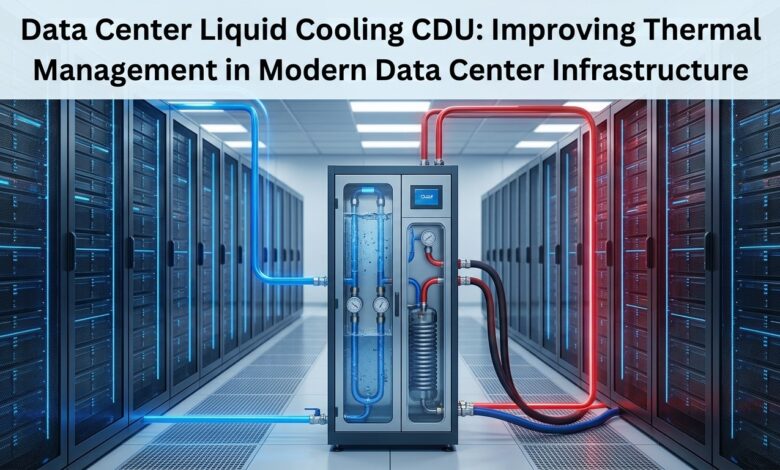
Modern data centers are processing larger workloads, supporting more powerful processors, and handling increasingly demanding applications. This growth has created a major challenge: heat. High-density servers can generate enormous thermal loads in a relatively small area, and conventional air cooling may not always provide the efficiency or precision needed for these environments. A Data Center Liquid Cooling CDU offers a practical solution by helping circulate and regulate coolant between computing equipment and facility cooling infrastructure. With better heat transfer, improved control, and greater scalability, liquid cooling is becoming an important part of modern data center thermal management.
Cooling Distribution Units, commonly known as CDUs, play a central role in this process. They help manage coolant temperature, pressure, flow, and heat exchange so that servers can operate within stable thermal conditions. Instead of relying only on large volumes of cooled air, liquid cooling can capture heat closer to processors, GPUs, memory systems, and other high-power components. This targeted approach can make cooling more efficient while reducing the risk of hotspots. For data centers focused on performance, reliability, and long-term infrastructure planning, a properly designed CDU can become a key element in creating a more responsive cooling environment.
Data Center Liquid Cooling CDU solutions from EXTRCOOL INDUSTRY LIMITED are designed to support effective thermal management in high-density computing environments. A CDU typically acts as an interface between the facility cooling loop and the secondary liquid loop connected to servers or racks. This separation helps maintain controlled coolant conditions while allowing thermal energy to move efficiently away from sensitive equipment. By regulating circulation and transferring heat through a dedicated heat exchanger, the CDU helps create a stable cooling process that can respond to changing workload demands. This is especially valuable in environments where computing density continues to rise and consistent temperature control is essential.
Efficient Heat Removal for High-Density Computing
One of the main advantages of liquid cooling is its ability to transfer heat more effectively than air. In traditional cooling systems, heat generated by servers must first move into the surrounding air before it can be carried away. As rack density increases, this process becomes more difficult because large amounts of airflow are required to remove concentrated heat.
Liquid cooling shortens that thermal path. Coolant can absorb heat directly from cold plates or other liquid-cooled components and transport it toward the CDU. The CDU then transfers that heat into the facility cooling system. Because the process is more direct, thermal energy can be removed quickly and consistently.
This makes liquid cooling especially useful for dense computing environments. More servers can potentially be operated within a smaller physical footprint without allowing heat to become a limiting factor. For facilities supporting artificial intelligence, scientific computing, analytics, cloud services, or other intensive workloads, this improved heat-removal capability can support greater computing performance while maintaining controlled temperatures.
Better Temperature Stability
Stable temperatures are essential for reliable data center operation. When server components experience excessive heat, performance can decline and protective systems may reduce processing speed. Temperature fluctuations can also place additional stress on equipment over time.
A CDU helps maintain consistent coolant conditions by continuously managing flow, pressure, and temperature. Sensors can monitor system performance, while pumps and control components can respond when thermal demand changes. If servers begin generating more heat, the system can increase coolant circulation to maintain suitable conditions.
This level of control can reduce the risk of localized hotspots and create a more predictable thermal environment. Rather than depending entirely on room-level cooling, data centers can manage heat closer to where it is generated. EXTRCOOL INDUSTRY LIMITED supports this approach by focusing on liquid cooling systems that are suited to modern high-density computing requirements.
Improved Energy Efficiency
Cooling is a significant part of overall data center energy use, especially when powerful equipment operates continuously. Traditional air-based systems may require substantial fan power, air handling, containment, and mechanical cooling. As server density increases, these requirements can become even more demanding.
A Data Center Liquid Cooling CDU can help improve efficiency by reducing dependence on high-volume airflow. Liquid can transport large quantities of heat through compact piping, which may reduce the amount of energy needed to move cooled air throughout the facility.
Variable-speed pumps can further improve efficiency. Instead of operating continuously at maximum output, the CDU can adjust coolant circulation based on actual heat loads. When demand decreases, pump speeds can be reduced. When workloads increase, the cooling system can respond accordingly.
This dynamic approach helps match cooling output with real computing requirements. Over time, better control of cooling energy can contribute to more efficient facility operation while supporting increasingly powerful hardware.
Supporting Scalable Data Center Infrastructure
Modern data centers rarely remain unchanged. New servers are added, rack densities increase, processors become more powerful, and computing requirements evolve. Cooling infrastructure therefore needs to support future growth rather than only current needs.
A modular liquid cooling approach can provide valuable flexibility. CDUs can be selected and configured according to required cooling capacity, rack density, redundancy needs, and expansion plans. Additional cooling resources can be introduced as computing infrastructure grows.
This scalability is especially useful for facilities transitioning from traditional air cooling to liquid cooling. Operators may begin by deploying liquid cooling in selected high-density areas while continuing to use air cooling elsewhere. Over time, the liquid cooling system can expand as more compatible equipment is introduced.
By planning for growth from the beginning, data center operators can avoid unnecessary redesigns and create a cooling architecture that evolves alongside computing demand.
Intelligent Monitoring and Control
Modern thermal management is increasingly driven by data. A CDU can provide real-time information about coolant temperature, pressure, flow rate, pump operation, and other important conditions. This visibility helps operators understand how effectively the cooling system is working.
Monitoring can also support preventive maintenance. Unexpected changes in flow or pressure may indicate a developing issue, while temperature differences can reveal changes in thermal performance. Detecting these conditions early allows maintenance teams to respond before server operation is affected.
Automation adds another layer of efficiency. Intelligent controls can adjust system operation according to changing workloads, helping maintain thermal stability without unnecessary energy consumption. This makes the cooling system more responsive and reduces the need for constant manual adjustment.
For data centers aiming to improve reliability, monitoring and automation can transform liquid cooling from a simple mechanical process into an actively managed part of the overall infrastructure.
Supporting Future Computing Demands
The computing industry is moving toward increasingly powerful hardware. High-performance processors, accelerators, and dense server architectures are likely to continue placing greater demands on cooling systems. Facilities that depend only on traditional approaches may face limitations as heat density rises.
Liquid cooling provides a way to prepare for these changes. A properly configured CDU can support higher thermal loads while maintaining controlled operating conditions. This gives data centers greater flexibility when adopting new computing platforms.
EXTRCOOL INDUSTRY LIMITED focuses on cooling solutions that align with the needs of high-density infrastructure, where effective heat transfer, precise control, and dependable operation are important. By incorporating scalable cooling into infrastructure planning, organizations can create a stronger foundation for future expansion.
Conclusion
A Data Center Liquid Cooling CDU can significantly improve thermal management in modern data center infrastructure. By controlling coolant circulation, maintaining stable temperatures, supporting efficient heat exchange, and reducing dependence on large volumes of airflow, the CDU helps create a cooling environment suited to high-density computing.
As workloads become more demanding and server power continues to increase, efficient thermal management will remain essential. Liquid cooling offers a direct and scalable way to remove concentrated heat, while CDU technology provides the control needed to keep the process reliable. For data centers focused on improving performance, energy efficiency, scalability, and long-term infrastructure readiness, this approach provides a strong foundation for modern cooling design.
Learn more about advanced liquid cooling solutions at https://www.extrcool.com/.