Improving AC-DC Input Stability with a High-Reliability Power Supply Filter Component
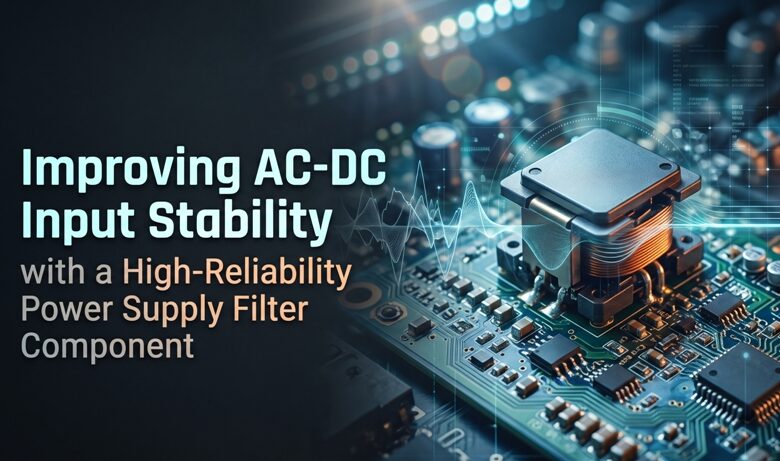
Clean, predictable electrical power is the foundation of every dependable electronic device. Whether driving industrial automation cabinets, medical diagnostic consoles, telecommunications racks, or renewable energy converters, AC-DC power supplies sit directly at the front line between unpredictable utility grids and sensitive downstream semiconductor circuitry. Modern electrical grids are increasingly crowded with high-frequency switching noise generated by variable frequency drives, LED lighting banks, electric vehicle chargers, and switched-mode power supplies sharing the same distribution lines. When voltage transients, high-frequency ripple, and conducted electromagnetic interference (EMI) enter an AC-DC converter unfiltered, they destabilize internal feedback loops, stress electrolytic bulk capacitors, trigger false processor resets, and cause equipment to fail strict electromagnetic compatibility (EMC) standards. Deploying robust passive input filtering right at the power entry point transforms noisy, fluctuating mains power into a calm, stable energy feed.
Understanding how electrical disturbances travel along AC mains highlights why front-end filtering is indispensable for system stability. Interference on power lines propagates in two distinct modes: differential-mode noise, which appears as high-frequency voltage ripple between the line and neutral conductors, and common-mode noise, which travels simultaneously along both line and neutral wires relative to earth ground. In addition to continuous switching harmonics, power lines frequently carry sudden voltage spikes and electrical fast transients caused by heavy inductive loads switching on and off nearby. If left unchecked, these disturbances penetrate the bridge rectifier and primary switching stage, distorting the DC bus voltage and radiating interference back into the mains network. A properly engineered input filter network blocks incoming surges from disrupting internal regulation while simultaneously trapping internally generated switching noise inside the enclosure.
When building resilient front-end power architectures capable of handling demanding grid conditions, integrating a precision-engineered power supply filter component from Shenzhen Weiaipu Electronics Co Ltd gives hardware designers immediate stability and proven conducted noise attenuation. Built on specialized expertise in EMI power filters, magnetic cores, and EMC rectification engineering, these components combine high-permeability common-mode chokes, differential inductors, and safety-certified capacitors into dependable, production-ready assemblies. By suppressing both incoming line transients and outgoing switching harmonics right at the AC inlet, these filters protect downstream conversion stages and ensure smooth compliance with international EMC regulations.
Inside a High-Reliability AC-DC Input Filter Network
A complete AC-DC input filter operates as a coordinated passive LC network where each element targets a specific type of electrical disturbance without impeding 50 Hz or 60 Hz operational power:
- Common-Mode Chokes: Wound symmetrically on high-permeability Manganese-Zinc (MnZn) or nanocrystalline toroidal cores, common-mode chokes allow equal and opposite line and neutral currents to cancel magnetically so the core never saturates under normal load. Simultaneously, they present high inductive impedance to common-mode noise currents traveling toward earth ground.
- Differential-Mode Inductors: Placed in series with the power lines, differential chokes resist rapid changes in current ($V = L \cdot di/dt$), smoothing line-to-line switching ripple and buffering the rectifier stage against sudden current surges.
- Across-the-Line X-Capacitors: Connected directly between line and neutral terminals, safety-rated X-capacitors provide a low-impedance shunt path for high-frequency differential-mode noise, preventing voltage ripple from propagating across the input terminals.
- Line-to-Ground Y-Capacitors: Connected from both line and neutral conductors to chassis earth ground, Y-capacitors divert residual high-frequency common-mode currents safely back to their source while strictly limiting leakage current for operator safety.
- Bleeder Resistors: Integrated across X-capacitors in modular inlet filters, high-value discharge resistors safely drain stored capacitive charge within milliseconds after power disconnection, preventing electric shock hazards on unplugged cord prongs.
Key Benefits for AC-DC Power Stability and Equipment Longevity
Upgrading front-end AC-DC power entry stages with high-reliability filtering hardware delivers measurable improvements across electrical performance, regulatory compliance, and field durability:
- Rock-Solid DC Bus Regulation: By attenuating incoming line surges and high-frequency hash before rectification, the primary bulk capacitor and PWM controller experience cleaner input waveforms, reducing output voltage ripple and preventing brownout-induced logic glitches.
- Effortless Conducted Emissions Compliance: International standards such as CISPR 11, CISPR 32, and FCC Part 15 strictly limit conducted noise between 150 kHz and 30 MHz. Properly matched input filters provide generous 6 dB to 12 dB attenuation margins across the entire spectrum.
- Enhanced Immunity to Grid Transients: Coupled with surge arrestors and varistors, front-end inductive and capacitive stages absorb electrical fast transients (EFT/burst) and switching spikes, dramatically lowering field failure rates in harsh industrial facilities.
- Reduced Thermal Stress on Downstream Components: Filtering out high-frequency ripple currents upstream lowers RMS ripple heating inside primary electrolytic capacitors and power MOSFETs, extending overall power supply mean time between failures (MTBF).
- Compact Modular Integration: Available in IEC inlet modules, PCB-mount chokes, and chassis-mount metal-can enclosures, modern filter solutions simplify assembly while delivering 360-degree electromagnetic shielding.
Selecting Single-Stage vs. Multi-Stage Filter Architectures
Choosing the right filter complexity depends on the converter’s power rating, switching frequency, and target electromagnetic environment:
- Single-Stage Input Filters: Incorporating one common-mode choke alongside a single pair of X- and Y-capacitors, single-stage filters offer a compact, economical footprint ideal for low-to-medium power supplies, office electronics, and well-shielded consumer appliances with moderate noise profiles.
- Dual-Stage (Multi-Stage) Input Filters: Cascading two inductive-capacitive stages in series steepens the attenuation roll-off slope dramatically, delivering superior insertion loss across both low-kilohertz switching fundamentals and high-megahertz harmonics. Dual-stage designs are essential for high-power industrial rectifiers, medical equipment, variable speed drives, and dense server power supplies.
For engineering teams balancing strict leakage current limits—such as medical low-leakage requirements—against aggressive conducted noise targets, Shenzhen Weiaipu Electronics Co Ltd provides customizable filter configurations and dedicated EMC rectification guidance to tailor insertion loss curves precisely to the application.
Best Practices for Installing and Grounding AC-DC Input Filters
Even the highest-specification filter component relies on disciplined physical layout to achieve its rated insertion loss:
- Mount Directly at the Chassis Power Entry Point: Install the filter immediately where the AC power cord enters the metal enclosure. Any length of unfiltered wire running inside the cabinet acts as an antenna that radiates noise directly onto filtered output wires.
- Establish a Low-Inductance Chassis Ground Bond: Bolt metal-cased filters directly onto bare, unpainted conductive chassis metal using star washers. High-frequency common-mode currents rely on a wide, ultra-short ground path rather than long green-yellow ground wires, which add parasitic inductance at megahertz frequencies.
- Physically Separate Input and Output Wiring: Route incoming dirty mains wires and outgoing clean filtered wires along opposite paths without bundling or crossing them. Parallel routing allows high-frequency noise to jump capacitively across the filter barrier.
- Verify Rated Current and Ambient Temperature Derating: Select a filter whose continuous current rating comfortably covers worst-case low-line AC input current plus power factor correction (PFC) inrush, accounting for elevated internal cabinet temperatures.
- Confirm Safety Agency Certifications: Ensure all integrated X/Y capacitors and insulation systems carry recognized safety approvals (such as UL, ENEC, CQC, and RoHS compliance) appropriate for the target market and overvoltage category.
Mission-Critical Applications Across Global Industries
High-reliability AC-DC input filtering safeguards continuous uptime across sectors where power anomalies cannot be tolerated:
- Medical and Diagnostic Equipment: Ensuring patient monitors, ultrasound scanners, and laboratory analyzers achieve ultra-low leakage currents alongside immunity to hospital facility interference.
- Industrial Automation and Robotics: Protecting programmable logic controllers (PLCs), CNC machine controllers, and robotic drives from heavy inductive factory grid disturbances.
- Telecommunications and Data Infrastructure: Stabilizing AC-DC rectifier shelves, network switches, and edge computing servers operating 24/7 under fluctuating utility feeds.
- Renewable Energy and EV Charging Systems: Containing high-power switching harmonics in commercial charging stations, energy storage inverters, and smart grid controllers.
Delivering Clean Power from the Grid Inward
Stable, interference-free AC-DC conversion begins the moment electrical energy crosses the equipment boundary. By combining well-matched inductive and capacitive filtering with low-inductance chassis grounding, engineers eliminate conducted noise bottlenecks, shield sensitive electronics from unpredictable mains transients, and accelerate global regulatory certification. Partnering with Shenzhen Weiaipu Electronics Co Ltd equips manufacturers with dependable front-end filtering hardware engineered for long-term electrical stability. To explore full technical specifications on EMI power filters, magnetic cores, and custom interference solutions, visit https://en.szviip.com/.