How to select a reliable CNC machining outsourcing manufacturer from China
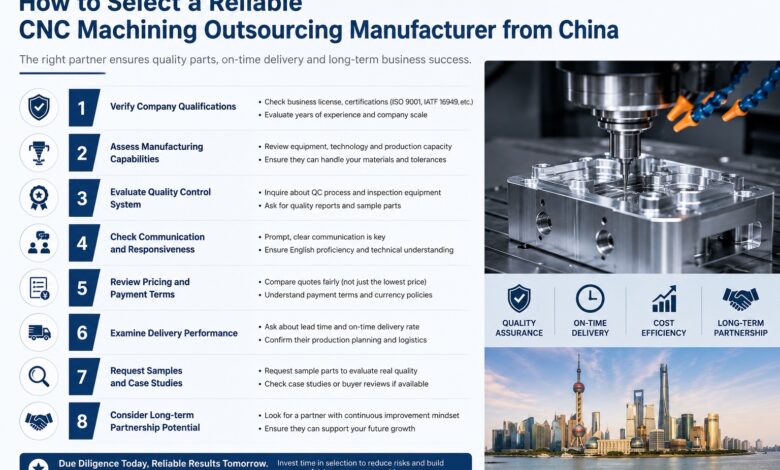
Outsourcing CNC machining can give your business access to skilled production teams, advanced equipment, flexible capacity, and competitive manufacturing costs. Yet choosing the right supplier is not as simple as sending a drawing and accepting the lowest quotation. Complex parts demand precise programming, stable machining processes, suitable materials, careful inspection, and clear communication. A reliable partner should make production easier, protect your design requirements, and deliver components that perform as expected.
China has become a major destination for CNC machining because manufacturers can support prototypes, small batches, and repeat production across a broad range of materials and part geometries. The large number of available suppliers creates plenty of opportunity, but it also means buyers need a practical evaluation process. Attractive prices can be useful, although price alone does not reveal whether a manufacturer can control tolerances, maintain consistency, or respond effectively when a design changes. The best selection decision balances technical capability, quality management, communication, delivery performance, and long-term cooperation.
CNC machining outsourcing manufacturer from China such as Shenzhen Diode Co.,Ltd can support customers who need professionally managed production for precision metal and plastic components. A capable supplier reviews the complete project rather than looking only at the visible shape of a part. Material behavior, cutting access, wall thickness, tolerances, surface requirements, inspection methods, and order quantity all influence the manufacturing plan. By examining these details before production, the machining team can reduce risk and create a more dependable path from digital design to finished component.
1. Define your technical requirements before contacting suppliers
A reliable selection process begins with a clear understanding of what you need. Prepare an accurate three-dimensional model, a detailed two-dimensional drawing, the required material, tolerance information, surface finish expectations, quantity, and delivery schedule. Mark critical dimensions so the manufacturer knows which features have the greatest effect on fit, motion, sealing, alignment, or assembly. When requirements are incomplete, suppliers may make different assumptions, which makes quotations difficult to compare.
It also helps to explain the application of the component. A machining team can make better decisions when it understands whether a part will experience heat, vibration, pressure, repeated movement, cosmetic inspection, or contact with another precision surface. This information does not replace the drawing, but it gives context to the technical requirements. Clear project information encourages accurate pricing, realistic lead times, and fewer production questions later.
Avoid applying extremely tight tolerances to every feature unless they are genuinely necessary. Unnecessary precision increases programming, machining, inspection, and rejection costs without improving the function of the part. A strong manufacturing partner may identify dimensions that can be relaxed while protecting the component’s performance. That kind of practical feedback is often an early sign that the supplier understands both engineering and production.
2. Evaluate machining capabilities carefully
Not every CNC machining supplier has the same equipment, experience, or process knowledge. Some workshops focus on straightforward turned parts, while others are better prepared for multi-surface components, deep cavities, thin walls, fine details, or complex contours. Ask whether the manufacturer can support the specific operations your design requires, such as milling, turning, drilling, tapping, boring, engraving, or multi-axis machining. The goal is to confirm that the supplier’s normal capabilities match your project instead of forcing the job into an unsuitable process.
Machine specifications are useful, but equipment alone does not guarantee quality. Skilled programming, correct tooling, stable workholding, and thoughtful operation sequencing are equally important. A manufacturer should be able to explain how it plans to reach difficult features, control deformation, maintain datum relationships, and inspect important dimensions. Clear technical explanations are more valuable than a long equipment list with no connection to your actual part.
For complex work, Diode Machining can be considered when evaluating production support that combines machining capability with practical process planning. The strongest supplier is usually the one that asks detailed questions and identifies potential risks before cutting material. Early technical discussion can prevent expensive redesigns, scrapped components, and avoidable delays.
3. Review material knowledge and sourcing control
Material selection has a direct effect on machining behavior, dimensional stability, surface quality, tool wear, and finished-part performance. A reliable manufacturer should understand the differences between commonly machined aluminum alloys, stainless steels, carbon steels, copper materials, brass, titanium, and engineering plastics. Each material requires appropriate cutting tools, feed rates, spindle speeds, cooling methods, and handling procedures. A process that works well for one material may create heat, burrs, distortion, or poor finishes in another.
Ask how the supplier verifies incoming material and prevents mix-ups. Depending on the application, you may need material certificates, traceability records, hardness information, or other supporting documentation. The manufacturer should also store materials properly and identify them clearly throughout production. These controls become increasingly important when several similar-looking alloys are used in the same facility.
Material sourcing should be included in the quotation discussion. Confirm the exact grade, condition, and form of the raw stock rather than accepting a general description. A lower quote may be based on a different material assumption, oversized tolerance, or limited documentation. Comparing equivalent specifications helps you judge pricing fairly and protects the quality of the finished parts.
4. Examine quality-control procedures
Quality inspection should be built into the manufacturing process rather than treated as a final check. Reliable suppliers inspect raw material, verify setups, monitor critical features during machining, and confirm finished dimensions before shipment. This layered approach makes it easier to detect problems early, when corrections are still possible. Waiting until the entire batch is complete can turn a small process error into a costly production failure.
Ask what measuring equipment will be used for your component. Standard tools may be suitable for simple dimensions, while complex surfaces, positional tolerances, deep features, or detailed profiles may require more advanced inspection methods. The supplier should connect the inspection plan to the drawing instead of measuring only the easiest dimensions. It should also understand geometric requirements such as flatness, perpendicularity, concentricity, profile, and true position where applicable.
Request a sample inspection report or proposed reporting format before placing a significant order. A professional report should identify the drawing dimensions, required limits, measured results, and inspection status. For repeat orders, consistent records help track process stability over time. Strong documentation also makes communication easier when your internal quality team reviews incoming components.
5. Start with a prototype or trial order
A prototype or small trial batch is one of the safest ways to evaluate a new outsourcing manufacturer. It allows you to review dimensional accuracy, surface finish, edge treatment, packaging, communication, and delivery performance before committing to a larger order. A successful sample does not guarantee that every future batch will be perfect, but it provides meaningful evidence of the supplier’s ability. It also gives both sides an opportunity to improve documentation and resolve unclear requirements.
Inspect the trial parts carefully in your own facility. Check not only the dimensions but also how the components fit, assemble, move, seal, or perform in their intended application. Small details such as burrs, sharp edges, tool marks, thread quality, cleanliness, and protective packaging can affect usability. Record any concerns clearly and send organized feedback rather than relying on general comments.
A responsible supplier should respond positively to technical feedback. It should explain the cause of any issue, propose corrective action, and show how the process will be improved. Defensive or vague responses can indicate weak process control. Constructive problem-solving, on the other hand, is a valuable sign of a manufacturer that wants to build a stable working relationship.
6. Compare quotations beyond the unit price
The cheapest quotation is not always the most economical choice. A low unit price can become expensive if parts arrive late, require rework, fail inspection, or create assembly problems. Review what each quotation includes, such as material, machining, setup costs, inspection, surface treatment, packaging, and shipping preparation. Confirm whether tooling or fixture charges are one-time costs or repeated with future orders.
Lead time should also be realistic. An unusually fast promise may be based on available capacity at the moment, but it may not reflect material purchasing, programming, fixture preparation, inspection, or outside finishing. Ask the supplier to explain the main stages of the schedule. A detailed timeline is more dependable than a simple delivery date with no process behind it.
Value comes from the complete result: accurate parts, predictable communication, reliable documentation, and timely delivery. A slightly higher quotation may provide better process control and reduce your total project risk. Focus on the cost of receiving usable components, not merely the cost written beside each unit.
7. Test communication speed and clarity
International outsourcing depends heavily on communication. Drawings, design revisions, tolerance questions, quantity changes, delivery updates, and quality feedback must all be handled accurately. A reliable supplier should respond within a reasonable period and address the actual question rather than sending a generic message. Clear written communication reduces misunderstanding and creates a useful project record.
Pay attention to the questions the manufacturer asks during quotation. Detailed questions about materials, datums, threads, surface finish, inspection, and application usually indicate a serious technical review. A supplier that quotes immediately without identifying obvious uncertainties may be making assumptions. Those assumptions can later lead to price changes, delays, or parts that do not meet your expectations.
Establish one main contact for the project whenever possible. That person should coordinate engineering, production, quality control, and logistics so information does not become fragmented. Regular updates are especially helpful for first orders and complex components. Good communication gives you visibility without requiring constant follow-up.
8. Assess design-for-manufacturing support
A valuable machining partner does more than follow instructions. It studies the design and suggests practical changes that can improve manufacturability, reduce cost, or increase process stability. These recommendations may involve adjusting an internal corner radius, increasing tool access, changing a very deep hole, improving wall thickness, or clarifying a datum structure. The final design decision remains yours, but experienced production feedback can reveal issues that are difficult to see in a digital model.
Design-for-manufacturing advice should preserve the component’s intended function. The supplier should explain why a change is recommended and what benefit it may provide. A suggestion that shortens machining time but weakens the part is not useful. The best recommendations balance engineering performance with realistic production methods.
Diode Machining may add value by reviewing project details before production and helping customers identify potential machining challenges. This collaborative approach can be particularly useful during prototyping, when design changes are easier and less expensive to make. Early cooperation often creates a smoother transition into repeat manufacturing.
9. Confirm surface finishing and secondary processes
Many CNC-machined parts require processes after machining, including polishing, blasting, anodizing, plating, heat treatment, painting, passivation, or laser marking. Even when these operations are completed by an approved external processor, your machining manufacturer should remain responsible for coordination and final inspection. Confirm which finishes are available and whether the quoted specifications match your drawing. Color, gloss, coating thickness, masking, and cosmetic acceptance criteria should be defined clearly.
Surface treatment can change dimensions, especially on holes, threads, sealing faces, and tightly fitted features. A capable manufacturer should account for coating thickness during machining and protect areas that must remain untreated. It should also inspect the parts after finishing because handling or processing can introduce scratches, distortion, or contamination. Final quality should be evaluated after every required operation is complete.
Ask how cosmetic parts are packed and separated. Precision surfaces can be damaged when components rub against one another during transport. Protective wrapping, individual compartments, caps, or custom trays may be appropriate depending on the geometry. Packaging is not a minor detail; it is the final step in preserving the quality already created during production.
10. Verify production capacity and delivery reliability
A manufacturer may produce a good prototype but struggle when order volume increases. Discuss expected quantities, repeat-order frequency, and possible future demand during the evaluation stage. The supplier should explain how it schedules machines, manages material availability, and maintains consistency across batches. This helps you determine whether it can support both current requirements and future growth.
Capacity should not be confused with an oversized facility. What matters is whether the manufacturer has enough suitable equipment, trained personnel, and inspection resources for your type of work. A smaller but well-organized operation can sometimes provide better control than a larger facility with weak coordination. Look for structured planning, realistic commitments, and evidence of repeatable processes.
Delivery reliability also depends on risk management. Ask how the supplier handles tool damage, machine maintenance, material delays, or unexpected inspection results. No manufacturing process is completely free from disruption, but responsible planning can limit the effect. Honest communication about a problem is far better than silence followed by a missed delivery date.
11. Protect drawings and design information
Your drawings, three-dimensional models, and product details may contain valuable intellectual property. Before sharing sensitive files, discuss how the manufacturer stores, accesses, and controls customer information. Project files should be limited to employees who need them for quotation, programming, machining, inspection, or order management. Clear confidentiality expectations should be established before production begins.
Use controlled file names and revision numbers for every drawing update. When a design changes, identify the revised features and confirm that the previous version has been removed from active production. Many manufacturing errors occur because an outdated file remains in use. A formal revision process protects both the buyer and the supplier.
Purchase orders should reference the correct drawing version, material grade, quantity, finish, inspection requirement, and delivery details. This creates a shared production standard and reduces uncertainty. Organized documentation may feel administrative, but it is one of the most effective ways to prevent avoidable mistakes.
12. Look for a long-term manufacturing relationship
The best outsourcing results often come from relationships that improve over time. As the manufacturer becomes familiar with your tolerances, materials, inspection preferences, packaging standards, and order patterns, projects can move more efficiently. Repeat work also allows proven fixtures, programs, tools, and quality plans to be reused. This consistency can reduce quotation time and improve delivery predictability.
A long-term supplier should remain flexible as your needs change. You may begin with prototypes, move into small-batch production, and later require regular orders or design revisions. A dependable partner supports each stage without losing control of quality. It should also continue reviewing performance rather than assuming that a previously successful process never needs adjustment.
Trust should be based on measurable results. Track delivery performance, inspection acceptance, communication quality, corrective actions, and responsiveness across multiple orders. These records help you make objective sourcing decisions. A positive relationship becomes most valuable when it is supported by reliable processes and consistent outcomes.
Final selection checklist
Before placing an order, confirm that the manufacturer meets the main requirements of your project:
- The supplier understands the drawing, model, materials, tolerances, and application.
- Its machining capabilities match the geometry and complexity of your components.
- It has suitable inspection methods for critical dimensions and geometric requirements.
- The quotation clearly includes material, machining, finishing, inspection, and packaging.
- Communication is responsive, specific, and technically useful.
- A prototype or trial batch has demonstrated acceptable quality.
- Revision control and confidentiality procedures are clearly established.
- Production capacity matches your current and expected order volume.
- Delivery commitments are realistic and supported by a defined process.
- The supplier provides practical design and manufacturing feedback.
Selecting a CNC machining outsourcing partner from China should be a structured decision rather than a price-only comparison. Clear requirements, technical evaluation, trial production, quality verification, and responsive communication provide a strong foundation for success. When these elements work together, outsourcing can reduce internal production pressure, improve access to specialized machining, and support faster product development. A dependable relationship also creates long-term value through repeatable quality, efficient cooperation, and smoother scaling.
For precision machining support and project information, visit https://diodemachining.com/.