Hot-Rolled vs. Cold-Rolled Steel Coils: Manufacturing, Specs, and Applications
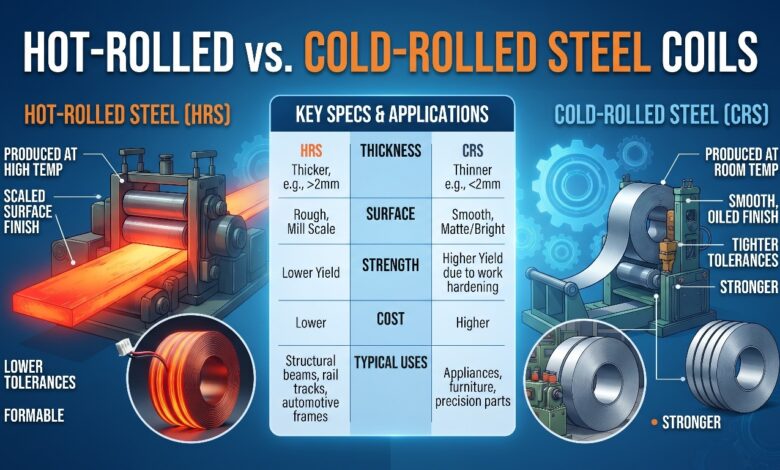
In modern industrial production, coiled sheet metal represents one of the most flexible and widely consumed structural commodities. From the mass production of passenger automobiles and household home appliances to heavy infrastructure columns and industrial piping, coiled raw materials allow manufacturers to stamp, slit, bend, roll-form, and weld parts with high operational efficiency. The two primary processing routes that define sheet products are hot rolling and cold rolling. While both begin with solid cast slabs, the distinct thermal regimes, reduction techniques, and surface treatment methods utilized during production impart fundamentally different mechanical properties, dimensional precision levels, and surface characteristics.
Selecting between these two processing categories requires a clear understanding of downstream operational parameters, functional performance requirements, cosmetic expectations, and cost structures. Misjudging material behavior can lead to split stampings, unexpected spring-back during bending operations, premature coating failures, or unnecessary manufacturing expenses. By examining the metallurgical foundations, dimensional tolerances, and typical use cases of each coil variant, production managers can make well-informed sourcing choices that optimize both processing yields and the longevity of the final product.
When procuring high-performance Steel Coil
products, Shandong Rigang Supply Chain Management Co Ltd offers a comprehensive selection of both hot-rolled and cold-rolled specifications engineered to satisfy demanding industrial standards. By maintaining strict control over chemical formulations and dimensional uniformity, specialized supply partners ensure that manufacturing operations proceed without unexpected downtime. This dependable access to certified stock allows fabrication plants to maintain consistent production cadences while upholding strict quality standards across diverse end-use sectors.
The Manufacturing Processes Explained
The fundamental difference between hot-rolled and cold-rolled coils stems from the operating temperature relative to the material’s recrystallization point:
- Hot-Rolled Coil Production: Solid steel slabs are reheated in a walking-beam furnace to temperatures well above 1,100°C, safely exceeding the recrystallization threshold. The glowing slab passes through roughing and continuous finishing mill stands where mechanical rollers exert immense compressive forces, dramatically reducing thickness. The strip is rapidly water-cooled along a run-out table to lock in target microstructures before being wound into tight coils on automated downcoilers. Because deformation occurs at high temperatures, the metal flows easily with low resistance, though exposure to atmospheric oxygen creates a rough oxide layer, known as mill scale.
- Pickling and Oiling (HRPO): For applications needing cleaner hot-rolled surfaces, the raw coil is uncoiled and passed through a continuous series of hydrochloric or sulfuric acid baths. This pickling process dissolves the brittle mill scale, after which the clean, matte-gray strip is rinsed, dried, and coated with a light oil film to prevent flash rust during transit and storage.
- Cold-Rolled Coil Production: Cold rolling is a secondary, room-temperature process performed on pickled hot-rolled master coils. The room-temperature strip passes through a series of multi-roll tandem reduction stands that compress the thickness by 50% to 90% without external heat. This plastic deformation causes severe work hardening, raising tensile strength while significantly lowering elongation.
- Annealing and Temper Passing: To restore ductility after intense cold reduction, coils undergo thermal annealing inside nitrogen- or hydrogen-purged furnaces, allowing new, stress-free crystalline grains to nucleate. After annealing, the softened strip undergoes a final “skin-pass” or temper rolling step. This light reduction pass (typically 0.5% to 2%) prevents stretcher strain markings during subsequent press work, establishes precise surface roughness, and ensures a flat strip profile.
Key Technical Specifications and Comparative Characteristics
Understanding the performance metrics of both variants helps engineers choose the most suitable grade for their manufacturing systems:
- Dimensional Tolerances: Cold-rolled coils exhibit exceptionally tight thickness and width tolerances, often within hundredths of a millimeter, along with exceptional flatness. In contrast, hot-rolled coils have slightly wider thickness tolerances due to uneven thermal shrinkage and mill roll deflection during high-temperature rolling.
- Surface Texture and Aesthetics: Cold rolling yields a smooth, clean, micro-textured surface that serves as an ideal substrate for electrostatic powder coating, high-gloss automotive painting, plating, or continuous galvanizing. Hot-rolled finishes have a darker, slightly textured appearance that works well for structural frameworks or components concealed inside machinery.
- Mechanical Integrity and Hardness: Hot-rolled materials possess low residual stress, meaning parts will not twist, bow, or distort when laser-cut, flame-cut, or machined. Cold-rolled grades feature higher yield strengths and hardness levels, but fabricators must account for internal work-hardening stresses during tight stamping or forming.
- Formability and Bending Limits: The refined grain structures of properly annealed cold-rolled coils allow for deep-drawing operations, complex contours, and tight radius bends without tearing. Standard hot-rolled material offers solid bending capabilities, but tight radii must be planned carefully to prevent edge cracking.
Industrial Applications for Hot-Rolled Coils
Due to its structural strength, cost-effective processing, and fabrication ease, hot-rolled coil is the preferred choice across heavy-duty sectors:
- Civil Infrastructure and Building Frames: Heavy purlins, secondary support channels, corrugated roofing decks, welded structural tubes, and gusset plates depend on hot-rolled strip to carry structural loads reliably.
- Automotive Structural and Chassis Parts: Vehicle suspension cradles, wheel rims, frame rails, subframes, and bumper reinforcements use heavy-gauge hot-rolled grades that provide structural stiffness and impact absorption.
- Line Pipe and Tubing: Continuous roll-forming mills transform slit hot-rolled strip into high-frequency welded (ERW) and spiral-submerged arc-welded (SSAW) pipes used to transport water, hydrocarbons, and industrial slurries.
- Storage and Shipping Containers: Standard intermodal shipping containers, rail cars, agricultural grain bins, and bulk storage bins rely on the rigid, easily welded nature of hot-rolled sheets.
Typical Uses for Cold-Rolled Coils
When tight dimensional tolerances, aesthetic consistency, and complex formability are paramount, cold-rolled strip is essential:
- Automotive Exposed Body Panels: Outer vehicle doors, hoods, fenders, roofs, and trunk lids demand the blemish-free surface finish and deep-drawing qualities of cold-rolled steel to achieve modern aerodynamic styling.
- Home Appliances and White Goods: Refrigerator wrappers, washing machine drums, dryer cabinets, microwave casings, and kitchen ovens require smooth, defect-free cold-rolled sheets that accept durable enamel or powder-coated finishes.
- Electrical Enclosures and Metal Furniture: Data server racks, industrial breaker boxes, office filing cabinets, and metal shelving units leverage the flat, sharp-edged consistency of cold-rolled steel.
- Precision Tooling and Stamped Hardware: Precision hinges, brackets, small motor laminations, and tight-tolerance pressings require uniform thickness across the entire coil width to avoid tooling jams in high-speed stamping presses.
Balancing performance requirements with budget constraints remains an essential step in modern manufacturing. By sourcing certified materials through seasoned global distributors such as Shandong Rigang Supply Chain Management Co Ltd, engineering teams secure verified coil products that comply with international metallurgical standards, minimize production scrap, and deliver reliable field performance.
For comprehensive details on product availability, technical specifications, and corporate background, please explore https://www.rgsteelfactory.com/about-us/
.

