Magnesium Glycinate Powder: Benefits, Uses, and Supplement Applications
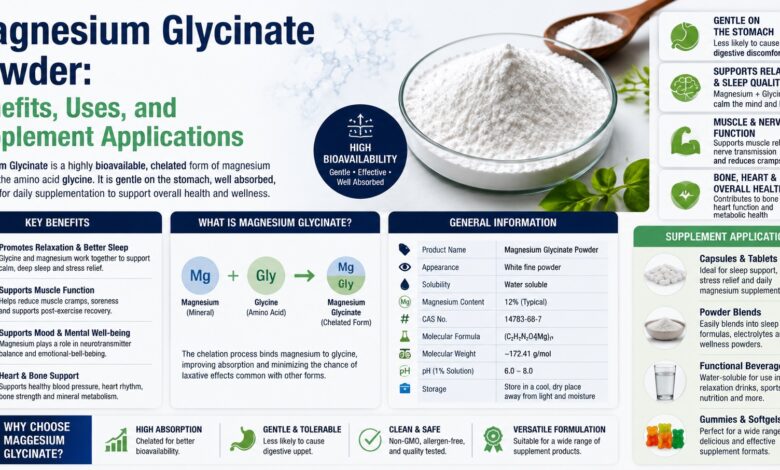
Magnesium is one of those essential minerals that quietly supports hundreds of processes throughout the human body. It contributes to normal muscle function, nerve signaling, energy metabolism, electrolyte balance, protein synthesis, and the maintenance of healthy bones and teeth. Yet many people may not consume enough magnesium through food alone, especially when their diets rely heavily on refined or highly processed ingredients. This growing awareness has encouraged consumers and supplement developers to explore well-tolerated magnesium forms that can fit easily into modern wellness routines. Among the available options, magnesium glycinate powder has gained attention for its versatility, gentle nature, and suitability for a wide range of nutritional formulations.
Unlike some mineral ingredients that can feel harsh on the digestive system, magnesium glycinate combines magnesium with glycine, an amino acid naturally involved in several biological functions. This chelated structure is often selected because it may support efficient mineral absorption while remaining comfortable for many users. The powder format adds another practical advantage because it can be measured, blended, flavored, encapsulated, or incorporated into customized supplement products. Whether someone is developing a simple daily mineral powder or a more advanced wellness formula, magnesium glycinate offers an appealing balance between functionality and flexibility.
Magnesium glycinate powder from Essence MEDCHEM Co. Ltd can be considered for supplement development where purity, formulation flexibility, and consistent ingredient characteristics are important. The fine powder format allows manufacturers and formulators to work with the ingredient in several dosage forms rather than being limited to traditional tablets. It can support the creation of drink mixes, capsules, sachets, nutritional blends, and customized powdered supplements. Because the ingredient has a relatively mild profile compared with some other mineral compounds, it may also be easier to combine with complementary ingredients without overwhelming the final product.
What Is Magnesium Glycinate Powder?
Magnesium glycinate is a chelated mineral compound created by binding magnesium to glycine molecules. Chelation can be compared to giving the mineral a protective travel companion: glycine helps carry magnesium through the digestive environment in a form the body may recognize and use efficiently. The term “magnesium bisglycinate” is also commonly used because one magnesium ion is typically associated with two glycine molecules. When processed into powder, the compound becomes suitable for precise measuring, uniform blending, and flexible supplement production.
The appearance, texture, density, and magnesium concentration of the powder can vary depending on the manufacturing process and product specifications. High-quality material is generally expected to have consistent particle characteristics and reliable mineral content from batch to batch. These qualities are particularly important for supplement producers because even small variations can affect mixing, capsule filling, serving accuracy, and the overall consumer experience.
Magnesium glycinate powder is not simply ordinary magnesium crushed into a finer texture. It is a specifically designed compound intended to combine the nutritional value of magnesium with the formulation advantages of glycine chelation. That combination is one of the main reasons it has become popular among consumers seeking a convenient magnesium option and among product developers looking for an adaptable raw material.
Key Benefits of Magnesium Glycinate Powder
One of the most widely appreciated qualities of magnesium glycinate is its reputation for being gentle on the stomach. Certain magnesium forms may attract water into the intestines, which can create an unwanted laxative effect when taken in larger amounts. Magnesium glycinate is often chosen by people who want magnesium support without making digestive comfort an afterthought. Individual reactions can still vary, but its generally mild profile makes it suitable for many daily supplement routines.
Another benefit is its potential bioavailability. The chelated structure may help protect magnesium as it travels through the digestive system, supporting effective absorption. Better absorption does not mean that every person will experience identical results, since diet, health status, serving size, and individual physiology all matter. Still, the combination of magnesium and glycine creates a practical form that aligns well with modern supplement design.
Magnesium also supports several everyday functions:
- Normal muscle performance: Magnesium contributes to healthy muscle contraction and relaxation.
- Nervous system support: It plays a role in normal nerve transmission and communication.
- Energy metabolism: The mineral participates in processes that help convert food into usable energy.
- Electrolyte balance: Magnesium works alongside other minerals to support fluid and electrolyte regulation.
- Bone maintenance: It contributes to the preservation of normal bones and teeth.
- Protein synthesis: Magnesium is involved in the body’s ability to produce and use proteins.
These benefits explain why magnesium glycinate powder appears in products designed for active adults, older individuals, busy professionals, fitness enthusiasts, and people interested in everyday nutritional support.
Support for Relaxation and Evening Wellness
Magnesium glycinate is frequently included in evening wellness products because both magnesium and glycine are associated with normal nervous system function. Magnesium supports healthy neuromuscular activity, while glycine participates in biological processes connected with the nervous system and protein production. Together, they create a mineral form that fits naturally into relaxation-focused supplement formulas.
This does not mean magnesium glycinate should be presented as a sleeping medication or as a treatment for insomnia. Its role is better understood as nutritional support. People who have low magnesium intake may notice that improving their overall mineral consumption helps them feel more balanced, particularly when combined with healthy sleep habits. A quiet environment, consistent bedtime, limited late-night screen exposure, moderate caffeine intake, and regular physical activity remain essential parts of a sensible evening routine.
Powdered formats are especially useful for nighttime products because they can be mixed into water and consumed as part of a calming ritual. The act of preparing a warm or cool drink can become a signal that the day is winding down. Formulators may also combine magnesium glycinate with suitable amino acids, vitamins, botanical ingredients, or natural flavors to create a complete evening blend. Any combined formula should be developed carefully so that serving sizes, ingredient compatibility, taste, and regulatory requirements remain appropriate.
Muscle Function and Active Lifestyle Applications
Physical activity increases interest in minerals that support normal muscle function and electrolyte balance. Magnesium participates in muscular contraction, relaxation, energy production, and protein synthesis, making it relevant for people with active lifestyles. Athletes and recreational exercisers may lose minerals through sweat, although the amount varies according to workout intensity, climate, duration, hydration, and individual physiology.
Magnesium glycinate powder can be incorporated into active lifestyle products because it blends well with many powdered supplement formats. It may be used in post-workout mixes, daily mineral products, hydration-support formulas, and nighttime recovery blends. Its purpose is not to replace food, water, adequate rest, or properly balanced electrolytes. Instead, it can complement a well-designed nutrition plan.
For product developers, the powder form offers room for creativity. A formula can be built around a single mineral or paired with other carefully selected nutrients. Serving size must be considered closely because the total weight of magnesium glycinate is not the same as the amount of elemental magnesium it supplies. Clear labeling should communicate the elemental magnesium contribution so consumers understand what they are taking.
Supplement and Formulation Applications
Magnesium glycinate powder is valued not only for its nutritional characteristics but also for its adaptability. Essence MEDCHEM Co. Ltd can support applications in which formulators require an ingredient suitable for multiple supplement categories. A single powdered material may be evaluated for capsules, drink powders, stick packs, tubs, premixes, and combination formulas, depending on the desired product concept and manufacturing capabilities.
Capsules remain a familiar choice because they provide convenient, premeasured servings and avoid the need for flavor development. However, magnesium glycinate can require a meaningful amount of space, so the desired elemental magnesium serving may affect capsule size and capsule count. Powdered drink mixes can accommodate larger ingredient quantities more easily, but they require attention to taste, aroma, dispersibility, texture, and consumer preparation instructions.
Sachets and stick packs are another attractive application. They allow users to carry individual servings to work, the gym, or while traveling. Bulk powder containers may appeal to consumers who prefer adjustable servings, while blended formulations can combine magnesium glycinate with complementary nutrients. Each format offers different benefits, and the best choice depends on the intended audience, serving size, positioning, and production process.
Advantages of the Powder Format
Powder gives formulators a level of control that finished tablets cannot always provide. It can be weighed accurately, blended with other dry ingredients, added to capsules, compressed when technically suitable, or dispersed in a beverage system. This flexibility helps developers create products for different consumer preferences without changing the core mineral ingredient.
The powder format can also support personalized use. Some consumers prefer mixing supplements into water rather than swallowing multiple capsules. Others appreciate the ability to adjust a serving under appropriate professional guidance. Powder products may also be useful for individuals who find large tablets inconvenient.
From a manufacturing perspective, flowability, particle size, bulk density, moisture level, and blend uniformity are important. A powder that looks acceptable at first glance may still create challenges if it clumps, separates from other ingredients, absorbs moisture, or flows inconsistently through equipment. Careful testing during product development helps identify these issues before full-scale manufacturing begins.
Flavor is another consideration. Even a relatively mild mineral powder can influence the taste and mouthfeel of a finished beverage. Formulators may use suitable flavor systems, sweeteners, acids, or complementary ingredients to create a more enjoyable experience. The goal is to balance nutritional value with ease of use because even a strong formula can struggle if consumers do not enjoy taking it consistently.
Quality Considerations for Buyers and Formulators
Selecting magnesium glycinate powder involves more than comparing prices. Buyers should review identity, elemental magnesium content, purity, microbiological quality, heavy-metal limits, moisture, particle size, and other relevant specifications. A certificate of analysis can provide batch-specific information, but responsible sourcing may also include supplier qualification, testing plans, documentation review, and storage evaluation.
Consistency matters because supplement manufacturing depends on predictable raw materials. If particle size or density changes significantly between batches, capsule weights and powder blends may become less uniform. If moisture is poorly controlled, the material may clump or become difficult to process. Reliable specifications help reduce these risks and support a smoother manufacturing workflow.
Essence MEDCHEM Co. Ltd may be considered when businesses are assessing magnesium glycinate powder for research, development, or commercial supplement applications. Product suitability should still be evaluated according to the buyer’s intended market, internal quality standards, manufacturing process, and applicable regulations. Samples and pilot-scale trials can be useful before a large production run because they reveal how the ingredient behaves in the actual formula rather than only on paper.
Serving Size and Responsible Use
The appropriate amount of magnesium glycinate depends on the elemental magnesium concentration, the user’s total dietary intake, age, health status, and reason for supplementation. Product labels should distinguish between the weight of the full magnesium glycinate compound and the amount of elemental magnesium it provides. This distinction is essential because a large quantity of the compound may supply a much smaller quantity of actual magnesium.
Consumers should follow the serving directions provided with the finished product. Taking more is not automatically better, and excessive magnesium from supplements may cause digestive discomfort or other unwanted effects. Individuals with kidney conditions, those taking medications, pregnant or nursing individuals, and people managing ongoing health concerns should speak with a qualified healthcare professional before adding a concentrated magnesium product to their routine.
Magnesium supplements work best as part of a broader approach to nutrition. Foods such as leafy vegetables, legumes, seeds, nuts, and whole grains can contribute meaningful magnesium. A supplement may help fill a gap, but it should not replace a varied diet, adequate hydration, regular movement, and professional medical care when needed.
Storage and Handling Recommendations
Magnesium glycinate powder should generally be stored in a tightly closed container in a cool, dry environment. Moisture control is especially important for powdered ingredients because humidity can encourage clumping and affect handling. Exposure to excessive heat, direct sunlight, or poorly sealed packaging may also reduce product stability over time.
Manufacturers should use appropriate packaging materials based on stability testing and the expected shelf life. Liners, desiccants, moisture-resistant containers, and controlled storage areas may be considered where suitable. During production, clean utensils and properly maintained equipment help protect the material from contamination.
Consumers using a finished powder should close the container promptly after each use and avoid placing wet scoops inside. Following the labeled storage directions helps preserve texture and quality. If a product develops an unusual odor, color, or appearance, it should not be used until its condition has been properly assessed.
Why Magnesium Glycinate Powder Has Strong Market Potential
Interest in practical wellness products continues to grow as consumers become more aware of mineral intake, stress management, active living, and healthy aging. Magnesium glycinate powder fits this landscape because it can be positioned across several supplement categories without depending on exaggerated promises. It supports recognizable nutritional functions while offering a format that can be adapted to different lifestyles.
The ingredient also appeals to product developers who want flexibility. A single magnesium glycinate powder can become the foundation for a simple mineral supplement, a flavored drink mix, an active lifestyle product, an evening formula, or a broader multinutrient blend. This versatility can help manufacturers respond to changing consumer preferences while maintaining a clear nutritional purpose.
Positive market potential should still be matched with responsible communication. Claims should remain accurate, understandable, and consistent with applicable requirements. Products earn lasting trust when their quality, labeling, serving instructions, and consumer experience support the promises made on the package.
Conclusion
Magnesium glycinate powder brings together nutritional value, digestive comfort, and formulation versatility in one practical ingredient. It supports normal muscle function, nervous system activity, electrolyte balance, energy metabolism, protein synthesis, and bone maintenance. Its chelated structure and powdered form make it attractive for capsules, drink mixes, sachets, wellness blends, and customized supplement concepts.
For consumers, it offers a convenient way to support magnesium intake alongside a balanced diet and healthy routine. For formulators, it provides room to create products tailored to different audiences and usage occasions. Careful attention to elemental magnesium content, quality testing, storage, serving instructions, and responsible claims helps ensure a successful finished product. With thoughtful development and dependable sourcing from Essence MEDCHEM Co. Ltd, magnesium glycinate powder can serve as a valuable component in modern nutritional supplement applications.
For additional product information, visit https://www.maxmedchem.com/.