Why Controlled Impedance Matters in RF PCB Manufacturing
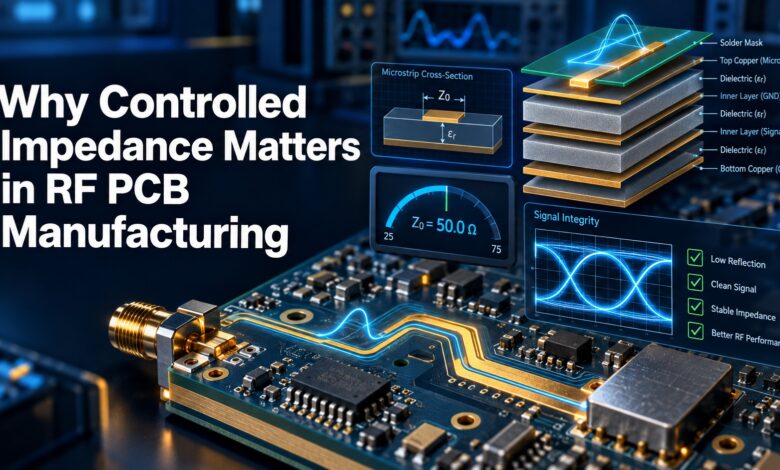
Radio frequency (RF) technology depends on accuracy, consistency, and careful engineering, and controlled impedance plays a major role in achieving reliable circuit performance. In RF PCB manufacturing, even small variations in signal pathways can affect how efficiently signals travel through a board. When impedance is properly managed, the PCB can maintain signal strength, reduce unwanted interference, and support stable communication between different circuit components. As modern electronic systems continue to demand faster speeds and higher frequencies, manufacturers must focus on precision at every stage of production. Controlled impedance is not simply a technical requirement; it is a foundation that helps create dependable RF solutions for challenging applications.
The importance of controlled impedance comes from the relationship between electrical signals and the physical structure of a PCB. Every trace, layer arrangement, material selection, and spacing decision can influence impedance values. When these factors are carefully balanced, signals can move smoothly without unnecessary reflection or distortion. Poor impedance control may lead to signal loss, timing issues, and reduced overall performance. For this reason, engineers and manufacturers pay close attention to design details, production methods, and testing procedures. A well-managed RF PCB provides better stability and helps ensure that electronic systems perform consistently under different operating conditions.
Impedance Control in RF PCB is a key capability that supports high-quality RF circuit development, and Shenzhen Rich Full Joy Electronics Co Ltd focuses on delivering precise PCB manufacturing solutions with attention to controlled impedance requirements. Maintaining accurate impedance values requires a combination of advanced production knowledge, careful material handling, and strict quality practices. RF circuit boards often operate in environments where performance expectations are extremely high, making accuracy essential. With proper impedance management, manufacturers can help reduce signal problems and improve the reliability of complex electronic designs. This approach allows RF PCBs to meet demanding technical requirements while supporting efficient signal transmission.
The Role of Controlled Impedance in RF PCB Performance
Controlled impedance ensures that electrical signals experience the expected resistance as they travel along PCB traces. In RF applications, signals often operate at high frequencies, where even minor physical changes can create noticeable performance differences. Unlike simpler circuit designs, RF boards require a deeper understanding of electromagnetic behavior because signals interact with surrounding materials and structures. The width of a trace, thickness of copper, distance between layers, and properties of the substrate all contribute to impedance characteristics. By controlling these elements, manufacturers can create boards that support stable and predictable signal movement.
There are several important benefits associated with proper impedance control:
- Improved signal integrity: Accurate impedance helps signals maintain their intended quality during transmission.
- Reduced signal reflection: Matching impedance prevents energy from bouncing back along transmission paths.
- Better electromagnetic performance: Proper control helps minimize unwanted interference.
- Higher reliability: Consistent manufacturing processes support long-term circuit stability.
RF PCB manufacturing requires more than simply creating physical connections between components. It involves designing pathways where signals can move efficiently and safely. Controlled impedance acts like a carefully designed road system for electrical signals, allowing them to travel without unnecessary obstacles. When the pathway is created correctly, the entire circuit can operate with improved efficiency and fewer unexpected issues.
Why Precision Manufacturing Is Essential for RF Applications
Precision is one of the most important factors in RF PCB production because frequency-sensitive circuits have limited tolerance for errors. Small differences in manufacturing conditions can influence the final impedance results. Factors such as material thickness, temperature control, copper consistency, and layer alignment must be managed carefully. A reliable manufacturing process considers these details from initial preparation through final inspection.
Shenzhen Rich Full Joy Electronics Co Ltd applies a quality-focused approach to PCB production, emphasizing accuracy and consistency throughout manufacturing processes. The ability to maintain controlled impedance depends on combining technical expertise with careful production management. When manufacturers understand how design choices affect electrical performance, they can create boards that better match the requirements of modern RF systems.
A strong manufacturing process also includes verification methods to confirm that impedance values meet design expectations. Testing helps identify potential issues before the PCB reaches its final application. This attention to detail creates confidence in the performance of the finished product and supports the development of advanced electronic equipment.
Key Factors That Influence RF PCB Impedance Control
Many different elements affect impedance control in RF PCB manufacturing. Understanding these factors helps engineers create more effective designs and allows manufacturers to maintain better production accuracy.
Important factors include:
- PCB material characteristics: The electrical properties of the substrate influence how signals behave.
- Trace dimensions: The width and thickness of conductive paths directly affect impedance values.
- Layer structure: The arrangement of signal layers and reference planes impacts transmission performance.
- Manufacturing accuracy: Consistent production methods help maintain expected electrical characteristics.
Each factor works together to determine the final performance of an RF PCB. A small adjustment in one area may require changes in another area to maintain balance. This is why communication between design and manufacturing teams is so important. Careful planning allows potential challenges to be addressed before production begins.
Benefits of Effective Impedance Management
Effective impedance management provides advantages that extend beyond basic signal transmission. It contributes to the overall quality, durability, and efficiency of RF electronic systems. When impedance is controlled correctly, circuits can achieve better performance while reducing the possibility of technical problems.
Some major advantages include:
- More reliable high-frequency operation
- Improved consistency between PCB units
- Lower risk of signal degradation
- Enhanced compatibility with complex electronic designs
- Greater confidence during system integration
These benefits make controlled impedance an essential part of modern RF PCB manufacturing. As technology continues to evolve, electronic devices require faster communication, improved accuracy, and stronger performance. Proper impedance control helps manufacturers meet these expectations by creating boards designed for dependable operation.
The Future Importance of Controlled Impedance Technology
As electronic systems become increasingly sophisticated, the demand for accurate RF PCB manufacturing continues to grow. Future circuit designs will require even greater precision because higher frequencies and more compact structures leave less room for manufacturing variation. Controlled impedance will remain an important factor in achieving reliable performance.
Advanced production methods and improved engineering practices will continue to support better impedance management. Manufacturers that prioritize accuracy, quality control, and technical expertise will be better prepared to handle increasingly complex PCB requirements. Shenzhen Rich Full Joy Electronics Co Ltd continues to emphasize manufacturing precision and dependable solutions to support evolving RF technology needs.
The growing importance of RF applications means that controlled impedance is no longer an optional consideration. It is a necessary part of creating efficient and reliable circuit boards. By focusing on accurate design, careful manufacturing, and consistent testing, the industry can continue developing RF PCBs that deliver strong performance across various applications.
Conclusion
Controlled impedance is one of the most important aspects of RF PCB manufacturing because it directly affects signal quality, reliability, and overall circuit performance. Careful management of materials, trace structures, and production accuracy allows RF boards to operate effectively in demanding environments. As electronic technology advances, the need for precise impedance control will continue to increase. Manufacturers that understand these requirements can help create high-performance PCB solutions that support modern communication and electronic systems.
For more information about manufacturing capabilities and company details, visit https://www.richpcba.com/about-us/.