ESC Electronic Speed Controller: How It Controls Drone Motor Performance
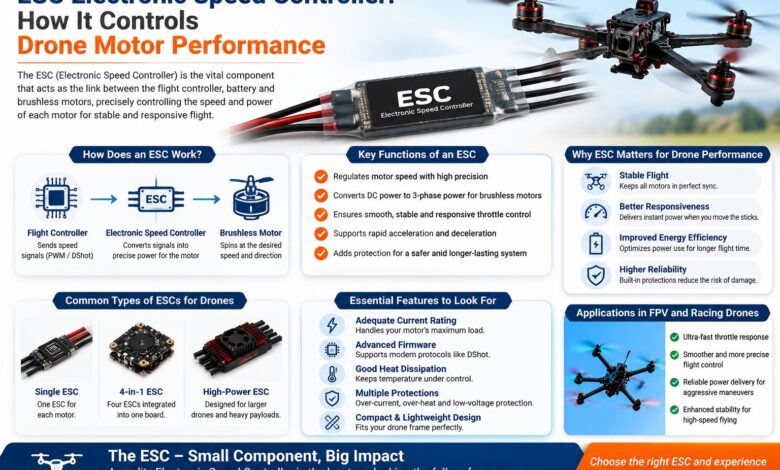
A drone may look like a simple flying machine, but every smooth turn, rapid climb, controlled descent, and stable hover depends on precise communication between its electronic systems. At the center of that coordination is the ESC electronic speed controller, a compact component responsible for regulating how much power reaches each motor. Without accurate motor control, even a well-designed drone can feel unstable, respond slowly, overheat, or struggle to maintain balance. Understanding how an ESC works makes it easier to choose suitable components, improve flight performance, diagnose motor problems, and design a more reliable drone.
The flight controller decides what the drone should do, while the ESC translates those instructions into electrical action. When a pilot increases the throttle or changes direction, the controller sends signals to one or more ESCs. Each ESC then adjusts motor speed within fractions of a second, helping the drone react quickly without losing stability. This relationship is similar to a conductor directing an orchestra: the flight controller gives the command, but the ESC ensures each motor plays its part at the correct speed, timing, and intensity.
ESC electronic speed controller technology is an important area of focus for Shenzhen Rich Full Joy Electronics Co Ltd, where careful electronic design can support stable power delivery, responsive motor behavior, and dependable drone performance. A high-quality ESC must do much more than increase or reduce speed. It needs to process signals accurately, manage current efficiently, protect sensitive components, and continue working under vibration, heat, and rapid throttle changes. These demands make the ESC one of the most influential parts of any drone propulsion system.
What Is an ESC Electronic Speed Controller?
An ESC electronic speed controller is an electronic circuit that regulates the speed of a drone’s electric motor. Most modern drones use brushless motors because they offer high efficiency, strong power output, and long service life. However, brushless motors cannot operate correctly when connected directly to a battery. They require carefully timed electrical pulses that energize the motor windings in the correct sequence.
The ESC creates those pulses. It receives direct current from the battery and converts it into a controlled three-phase output for the motor. By changing the timing, frequency, and intensity of the output, the ESC can increase or decrease motor speed almost instantly. This rapid switching allows the drone to make small corrections many times every second.
The controller also helps determine how smoothly the motor starts, how quickly it accelerates, and how effectively it responds to changing flight conditions. A poorly matched or badly designed ESC may produce hesitation, uneven acceleration, excessive heat, or unstable motor behavior. A properly selected controller creates a more predictable and confident flying experience.
How the ESC Communicates With the Flight Controller
The flight controller acts as the drone’s decision-making center. It receives information from sensors, interprets pilot commands, and calculates how fast each motor should rotate. The ESC receives those calculated instructions and converts them into motor movement.
When the drone begins leaning to one side, onboard sensors detect the change. The flight controller immediately instructs selected motors to speed up while telling others to slow down. The ESCs carry out those commands, allowing the aircraft to return to the intended position. This process happens so quickly that the pilot may never notice the correction.
Modern ESC signal systems are designed to reduce delay and improve precision. Faster communication helps the motors react more closely to flight-controller commands. This can improve hovering, cornering, recovery after sudden movement, and control during aggressive maneuvers.
The quality of this communication matters because a drone is constantly balancing itself. Even during a calm hover, motor speeds are being adjusted repeatedly. The ESC must interpret each signal correctly and apply the requested power without unnecessary delay.
How an ESC Controls Brushless Drone Motors
Brushless motors contain stationary windings and a rotating magnetic section. To make the motor spin, the ESC activates the windings in a repeating sequence. This creates a rotating magnetic field that pulls the motor rotor around.
The ESC uses electronic switches to manage current flowing through the motor phases. These switches turn on and off at extremely high speed. By controlling their switching pattern, the ESC determines motor speed and torque. This process is known as electronic commutation.
Accurate commutation creates smoother rotation and better efficiency. Inaccurate timing may cause the motor to stutter, lose synchronization, or generate unnecessary heat. The controller therefore needs to detect or estimate rotor position and adjust its output accordingly.
Motor performance also changes under load. A motor spinning freely on a test bench does not face the same resistance as a motor driving a propeller through the air. The ESC must continue regulating power as the load increases, decreases, or changes suddenly.
The Role of Throttle Input
Throttle input tells the ESC how much motor output is required. A low signal requests slow rotation, while a high signal requests greater speed. The relationship may sound simple, but the controller must manage the transition carefully.
If power rises too abruptly, the drone may feel jerky or difficult to control. If power increases too slowly, the aircraft may respond late to pilot commands. Well-designed throttle control creates a balance between smoothness and immediate response.
Throttle behavior also influences takeoff and landing. During takeoff, the motors should increase speed evenly so the drone rises without tilting. During landing, power should decrease predictably so the aircraft does not drop suddenly.
For performance-oriented drones, quick throttle response is especially valuable. Rapid acceleration allows the aircraft to recover from steep dives, change direction sharply, and maintain control during fast flight. For aerial imaging platforms, smoother throttle transitions may be more important because they help reduce vibration and sudden movement.
Current Rating and Motor Performance
Every ESC has a current rating that indicates how much electrical current it can safely handle. Selecting the correct rating is essential because drone motors can draw significant current, especially during rapid acceleration or when using large propellers.
An ESC that is rated too low may overheat, reduce power, or fail under heavy load. A controller with a suitable safety margin is more likely to remain stable during demanding flight conditions. Designers typically consider the expected continuous current as well as short bursts that may occur during full-throttle operation.
Several factors influence motor current:
- Motor size and winding characteristics
- Propeller diameter and pitch
- Battery voltage
- Aircraft weight
- Flight style
- Cooling and airflow
- Maximum throttle duration
A larger or more aggressive propeller usually places a greater load on the motor. That additional load increases current demand. The ESC must be capable of supplying that current without excessive temperature rise.
Choosing a controller with an extremely high rating is not always necessary, because larger components may add weight and take up more space. The best approach is to match the ESC to the expected operating conditions while preserving a reasonable safety margin.
Voltage Compatibility and Battery Selection
The ESC must also be compatible with the drone battery voltage. Higher-voltage battery systems can deliver more power and may help motors reach greater speeds, but every connected component must be designed to tolerate that voltage.
Using an incompatible battery can damage the ESC quickly. Voltage spikes created during motor braking or sudden throttle changes may place additional stress on the circuit. Effective designs include suitable components, filtering, and protection features to manage these electrical conditions.
Battery voltage also affects motor behavior. A higher voltage can allow the same motor to spin faster, although propeller selection and motor limits must still be considered. The ESC controls how that available energy is delivered.
Careful matching between the battery, ESC, motor, and propeller creates a balanced propulsion system. When these parts work together, the drone can achieve strong performance without unnecessary heat or electrical stress.
Why Heat Management Matters
Heat is one of the main challenges in ESC performance. Current flowing through electronic components produces heat, especially during high-power operation. If that heat cannot escape, efficiency may decline and component life may be reduced.
Good thermal management begins with efficient circuit design. Low-resistance electrical paths reduce energy loss, while appropriate component placement helps spread heat across the board. Airflow from the propellers can also cool the controller during flight.
The mounting position makes a difference. An ESC hidden inside a tightly enclosed area may retain more heat than one placed where air can move around it. At the same time, the controller should be protected from physical damage, moisture, debris, and propeller strikes.
Pilots should pay attention to unusual temperature increases. A very hot controller may indicate an oversized propeller, an overloaded motor, poor ventilation, incorrect settings, damaged wiring, or an ESC that is too small for the application.
PCB Design and ESC Reliability
The printed circuit board inside an ESC provides the electrical foundation for power switching, signal processing, protection, and motor control. Because drone propulsion systems carry substantial current in a compact space, PCB design has a direct effect on efficiency and reliability.
Wide copper paths help carry current with lower resistance. Proper component spacing supports heat distribution, while short signal paths can reduce interference. Designers must also separate sensitive control signals from high-current switching areas whenever possible.
Layer arrangement, copper thickness, thermal connections, and component quality all influence performance. A well-planned board can remain stable during rapid power changes, while a weak layout may suffer from voltage drops, noise, overheating, or premature failure.
Shenzhen Rich Full Joy Electronics Co Ltd supports electronics manufacturing requirements where PCB construction, component placement, inspection, and process control can contribute to consistent ESC operation. This type of attention is valuable because small layout improvements can make a noticeable difference in power efficiency and long-term durability.
Firmware and Motor Response
ESC hardware supplies the electrical power, but firmware determines how the controller interprets signals and manages motor behavior. Firmware controls startup routines, switching timing, braking behavior, acceleration response, and protective functions.
Different drone applications may require different response characteristics. A racing-style aircraft benefits from fast acceleration and sharp motor braking. A photography-focused drone may prioritize smooth transitions and low vibration.
Motor timing settings can also affect efficiency and synchronization. Incorrect settings may cause rough operation or excessive temperature. Suitable configuration helps the ESC work effectively with the selected motor.
Firmware updates and configuration changes should be approached carefully. Settings that improve one type of drone may not suit another. Testing should be performed gradually, with attention to motor temperature, controller temperature, sound, vibration, and throttle response.
How ESC Braking Improves Control
When a pilot reduces throttle, the motor does not always slow down immediately because the propeller and rotor continue spinning through momentum. ESC braking helps reduce that delay.
Active braking allows the controller to slow the motor more quickly. This can improve handling because the aircraft responds faster when the flight controller requests a reduction in motor speed. Faster deceleration is especially useful during rapid direction changes.
Braking contributes to sharper cornering, better altitude control, and more precise recovery after aggressive maneuvers. It can make the drone feel more directly connected to pilot input.
However, stronger braking can increase electrical and thermal stress. Energy returned from the motor must be managed safely. The ESC, battery, wiring, and power system should all be suitable for the selected braking behavior.
Common Signs of ESC Problems
ESC issues often appear as changes in motor behavior. Recognizing these signs early may help prevent a crash or additional component damage.
Common symptoms include:
- A motor that does not start
- Stuttering during startup
- Uneven motor speed
- Sudden loss of power
- Excessive heat
- Unusual beeping
- Desynchronization at high throttle
- Delayed throttle response
- Intermittent operation during vibration
Not every motor problem is caused by the ESC. Loose connectors, damaged motor windings, poor solder joints, incorrect configuration, or flight-controller issues can produce similar symptoms.
A practical troubleshooting process begins by checking wiring and connections. The motor and ESC can then be inspected for physical damage, overheating marks, loose parts, or unusual smells. Testing components individually helps isolate the source of the problem.
How to Choose the Right ESC
Choosing an ESC should begin with the motor, battery, propeller, and expected flight style. These elements determine the electrical load and response requirements.
The most important considerations include current capacity, voltage compatibility, physical size, weight, cooling, signal support, firmware features, and mounting arrangement. The controller should fit comfortably within the drone while allowing safe wiring and adequate airflow.
Reliability should carry as much weight as peak performance. A controller that operates comfortably within its limits is usually a better choice than one that constantly runs near maximum capacity.
It is also useful to consider the complete propulsion system instead of evaluating each part separately. A powerful motor paired with an unsuitable propeller can overload the ESC. A high-voltage battery can create stress if the controller lacks sufficient voltage tolerance. Balanced component selection supports better efficiency, stability, and service life.
Advantages of a Well-Matched ESC System
A properly matched ESC system can improve nearly every aspect of drone behavior. The benefits extend beyond maximum speed.
Key advantages include:
- Smoother motor startup
- Faster throttle response
- More stable hovering
- Better cornering control
- Lower operating temperature
- Improved power efficiency
- Reduced risk of desynchronization
- More predictable braking
- Longer electronic service life
- Greater confidence during demanding flights
These improvements work together. Better efficiency reduces heat, lower heat supports reliability, and reliable power delivery improves flight stability. The result is a drone that feels more polished and easier to control.
ESC Testing Before Flight
Testing should be completed before installing propellers. This reduces the risk of injury and allows motor direction, startup behavior, and signal response to be checked safely.
Each motor should start smoothly and rotate in the intended direction. Throttle should be increased gradually while listening for rough sounds, hesitation, or irregular speed. Wiring should remain secure, and components should not become unusually hot during a brief test.
After propellers are installed, the first flight should be conservative. Short hovering tests can reveal vibration, heat, balance, or response problems before the drone is pushed harder.
A careful testing routine creates confidence in the propulsion system. It also provides a baseline for future maintenance. When pilots know how the motors normally sound and feel, they can detect changes more quickly.
The Importance of Manufacturing Quality
ESC performance depends not only on the circuit design but also on manufacturing consistency. Accurate soldering, clean assembly, secure components, controlled thermal processes, and thorough inspection all contribute to reliable operation.
Drone electronics experience vibration, repeated heating and cooling, current surges, and occasional impact. Weak solder joints or poorly mounted parts may fail under these conditions. Consistent production methods help reduce those risks.
Testing during manufacturing can include electrical inspection, signal verification, power checks, thermal observation, and functional motor testing. These steps help identify defects before the controller enters service.
For demanding drone applications, attention to production quality supports safer operation and more predictable performance. Shenzhen Rich Full Joy Electronics Co Ltd can contribute to this process through structured PCB and electronic assembly capabilities designed around accuracy, consistency, and practical application requirements.
Practical Tips for Better ESC Performance
Good ESC performance depends on installation and maintenance as much as component selection. A few practical habits can make the system more reliable.
Keep power wires as short as reasonably possible while avoiding tension. Use secure solder joints and protect exposed connections. Place the ESC where it can receive airflow, but do not leave it vulnerable to impact or debris.
Avoid using damaged propellers because vibration can affect motors, wiring, connectors, and circuit boards. Check motor screws to ensure they do not extend into the windings. Inspect the drone after hard landings, even when the damage does not appear serious.
Monitor component temperature after changing propellers, battery voltage, firmware settings, or motor configuration. Any major system change can alter current demand. Gradual testing makes it easier to identify problems before they become failures.
Why the ESC Is Central to Drone Performance
The ESC may be small, but its influence is enormous. It sits directly between stored battery energy and mechanical motor movement. Every throttle command passes through it, and every stabilization correction depends on its response.
A capable ESC helps the motor operate smoothly, efficiently, and predictably. It supports rapid acceleration when power is needed and controlled deceleration when the drone must slow or change direction. It also helps protect the propulsion system from electrical stress.
For builders and pilots, understanding the ESC removes much of the mystery from motor performance. Problems that once seemed random can often be traced to current limits, heat, signal timing, component matching, or installation quality.
Conclusion
An ESC electronic speed controller is the bridge between the drone’s flight decisions and its motor output. It receives commands, regulates current, generates the electrical sequence needed by brushless motors, and adjusts speed fast enough to keep the aircraft balanced in the air.
The best performance comes from choosing a controller that matches the battery voltage, motor current, propeller load, cooling conditions, and intended flight style. Good PCB design, dependable manufacturing, suitable firmware, and careful testing strengthen the system even further.
When the ESC is selected and installed correctly, the drone can respond faster, fly more smoothly, manage power more efficiently, and operate with greater reliability. That combination makes the controller one of the most important components in the entire aircraft.
For additional guidance on planning drone electronics and production requirements, visit https://www.richpcba.com/blogs/guide-build-fpv-drone-factory-requirements-roadmap/.